
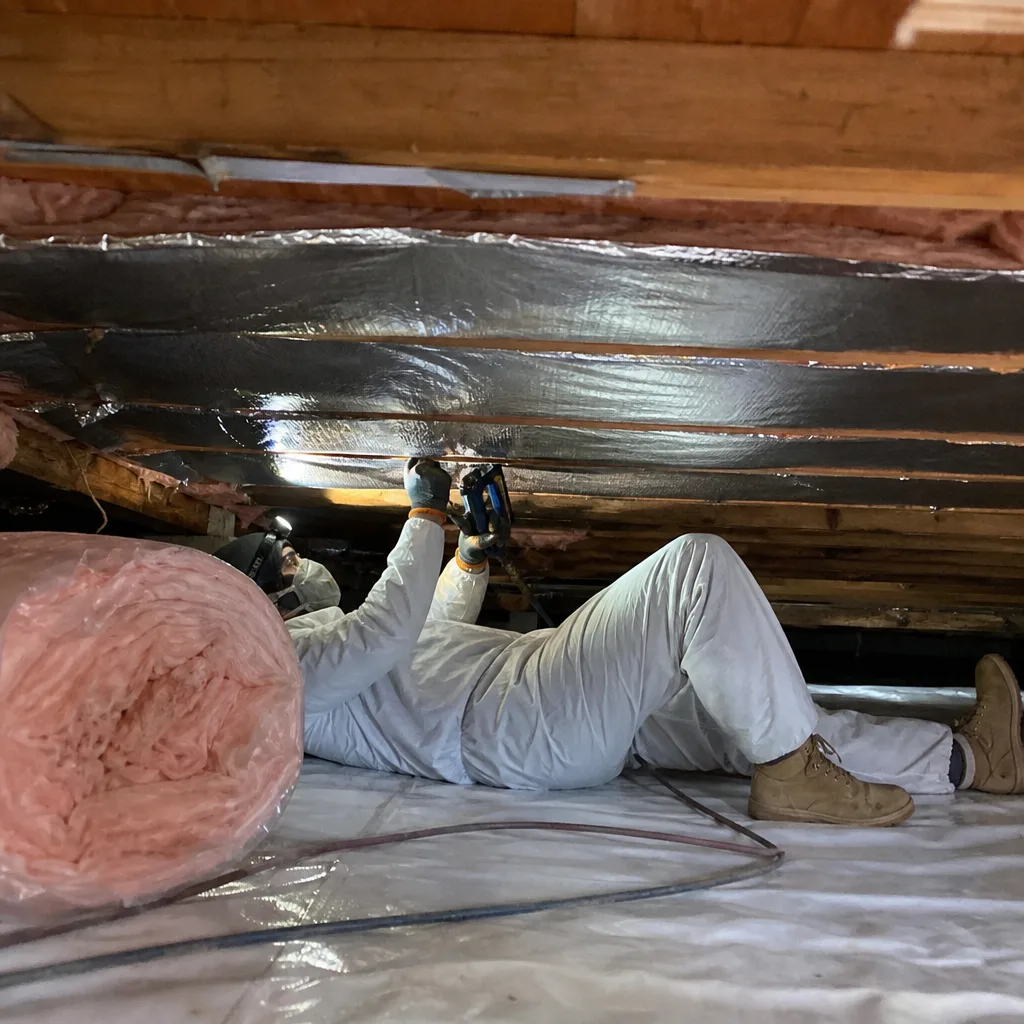
How Much Does Crawl Space Encapsulation & Vapor Barrier Cost in Orange?
Crawl space encapsulation in Orange, CA typically runs between $3,000 and $8,500 for a standard single-family home, with most Orange homeowners landing somewhere around $4,500 to $6,000 for a full encapsulation including a 20-mil vapor barrier, drainage matting, and sealed vents. A vapor barrier-only installation (without full encapsulation) costs less – usually $1,200 to $2,800 – but rarely solves the moisture problem completely in older Orange homes where gaps, vents, and pier penetrations let humid air back in.
Crawl Space Encapsulation & Vapor Barrier Cost Breakdown (2026)
Here’s how the numbers typically break down for an Orange, CA crawl space project. These ranges reflect what we actually see on jobs in this market – not national averages padded with buffer numbers.
| Service / Component | Typical Price Range (Orange, CA) | Notes |
|---|---|---|
| Vapor barrier only (6-mil poly) | $800 – $1,500 | Basic code-minimum; adequate for very dry crawl spaces |
| Vapor barrier (12-mil or 20-mil reinforced) | $1,200 – $2,800 | Better durability; appropriate for most Orange homes |
| Full encapsulation (barrier + sealed vents + tape seams) | $3,000 – $5,500 | Most common full-service project in this market |
| Full encapsulation + drainage matting | $4,000 – $6,500 | Recommended where ground moisture is consistent |
| Full encapsulation + dehumidifier installation | $5,500 – $8,500 | For crawl spaces with active moisture intrusion |
| Debris/old insulation removal (pre-encapsulation) | $400 – $1,200 | Often necessary in homes built before 1990 |
| Pier wrapping and penetration sealing | $150 – $400 | Add-on; critical for airtight encapsulation |
| Vent sealing (per vent) | $30 – $80 | Number of vents varies widely by floor plan |
The biggest swing factor is crawl space square footage. A 600-square-foot crawl under a smaller Orange bungalow near the Old Towne district costs meaningfully less than a 1,800-square-foot crawl under a larger tract home in the Chapman Hills or Serrano Heights areas. Access also plays a role – a crawl space with a standard access hatch on the exterior usually runs 10 to 15 percent less in labor than one where the only access is through a tight interior floor panel. And if we open the crawl space and find degraded fiberglass batts, rodent nesting, or standing water damage – things that are common in homes along Santiago Creek where seasonal moisture patterns affect the soil – there’s additional remediation work before encapsulation can begin.
At Harbor Insulation Orange, every job starts with a home energy audit and a thorough crawl space inspection. We audit before we recommend. That means you get a real scope of work, not a guess quoted sight-unseen over the phone.
What Affects Crawl Space Encapsulation & Vapor Barrier Pricing in Orange
Six factors drive most of the cost variation we see on Orange crawl space jobs. Understanding them helps you evaluate any quote – ours or anyone else’s.
- Crawl space size and height. Most Orange homes have crawl spaces ranging from 400 to 2,000 square feet. Labor time scales directly with size, and tight vertical clearance (anything under 18 inches) adds time because of how physically difficult the install becomes. Homes in older neighborhoods like Friendly Hills and Eisenhower Park frequently have lower clearances than newer builds.
- Vapor barrier mil thickness and material grade. A 6-mil poly sheet meets California’s minimum code requirement but won’t hold up long under foot traffic or shifting soil. We typically recommend 12-mil or 20-mil reinforced barriers for Orange homes because they last longer and seal better around piers and footings. The cost difference between 6-mil and 20-mil across a 1,000-square-foot crawl is roughly $400 to $800 – money that pays back quickly in performance.
- Sealed vs. vented crawl space design. California Building Code Section R408 covers foundation ventilation requirements. Converting a traditionally vented crawl space to a fully conditioned, sealed encapsulation system requires closing off all existing vents and often adding mechanical ventilation or a dehumidifier to maintain air quality. That conversion adds $600 to $2,000 to a project depending on vent count and the method used to seal them.
- Pre-existing conditions in the crawl space. In Orange, homes built between 1950 and 1985 frequently have deteriorating kraft-faced fiberglass batts stapled to the subfloor above, debris accumulation, and sometimes signs of past rodent activity. None of that can stay in place under new encapsulation. Removal and disposal runs $400 to $1,200 depending on how much material is involved – and skipping it voids the performance benefit of the new barrier.
- Soil moisture and drainage conditions. Orange sits in the Santa Ana River watershed, and soil moisture patterns vary noticeably between the flatter areas near the 57 freeway corridor and the hillside properties around Peralta Hills and Cowan Heights. Hillside homes with clay-heavy soil tend to hold moisture longer after rain events. Those jobs often benefit from drainage matting under the vapor barrier, which adds $500 to $1,500 but prevents barrier displacement and pooling beneath the liner.
- Access and job site logistics. A crawl space with exterior access, adequate clearance, and no debris moves fast. One accessible only through a 20×20-inch interior hatch, with six inches of clearance, packed with old insulation, and showing signs of previous pest activity – that’s a completely different labor equation. We factor this in up front during inspection so there are no surprise charges mid-job.
Vapor Barrier vs. Full Encapsulation: Which Does Your Orange Home Need?
This is the question most Orange homeowners ask first, and the honest answer is that it depends on what’s actually happening in your crawl space – which is why we look before we quote.
A vapor barrier alone (the plastic sheeting laid across the ground) works adequately when the crawl space is dry, well-ventilated, and has no significant moisture intrusion. If you’re seeing high humidity readings (above 60 percent relative humidity in the crawl), efflorescence on the footings, soft subfloor material, or musty odors making their way into the living space, a barrier alone won’t fix the underlying problem. You’re just covering a wet floor with plastic.
Full encapsulation seals the entire crawl space – floor, walls, piers, penetrations, and vents – turning it into a conditioned semi-interior space. This approach eliminates the air exchange between the exterior soil environment and your crawl space, which is where the bulk of moisture problems originate. In Orange’s climate, where marine air from the coast can push humidity inland during late spring and summer, a sealed crawl space maintains more stable conditions year-round than one that breathes with the outside air.
Our Crawl Space Encapsulation & Vapor Barrier in Orange service covers both approaches, and we’ll tell you honestly which one your home needs after we’ve actually inspected the space – not before.
Orange, CA Local Factors That Influence Crawl Space Moisture
National cost guides treat “Southern California” as one climate, but Orange has local conditions worth understanding if you’re trying to figure out why your crawl space has a moisture problem in the first place.
The City of Orange sits at roughly 200 to 600 feet elevation depending on the neighborhood. Lower-lying areas near the 22 freeway and the older residential tracts in West Orange experience more ground moisture than elevated properties above Chapman Avenue. Homes near Santiago Creek and Irvine Park Road have historically dealt with seasonal soil saturation during heavy rain years – and 2023 and 2024 were heavy rain years across Orange County.
Soil type matters too. Much of central Orange sits on loam and alluvial fill that drains reasonably well, but clay-heavy subsoil pockets in the hills retain moisture for weeks after a significant rain event. When that moisture has nowhere to go, it migrates upward through capillary action and into the crawl space atmosphere. A vapor barrier with proper drainage matting interrupts that process at ground level.
Orange homes built before 1980 often have crawl spaces that were designed with the vented-crawl assumption that was standard building practice at the time. That design made sense in drier climates. In a coastal-influenced area like Orange County, vented crawl spaces effectively invite outdoor humidity indoors every time conditions are right. Converting those crawl spaces to sealed encapsulation typically produces a measurable improvement in floor-level temperatures and indoor air quality – benefits that show up in energy bills and, frankly, in how the house smells.
How to Save on Crawl Space Encapsulation & Vapor Barrier
There’s a real difference between spending less and spending smart. Here’s where it’s worth pushing back on cost – and where cutting corners will cost you more in the long run.
- Get an accurate inspection before committing to scope. The fastest way to overspend on a crawl space project is to agree to a full encapsulation when your crawl space actually needs a heavy-duty vapor barrier and better drainage matting. Conversely, spending $1,400 on a basic barrier when you have an active moisture issue just means you’ll be spending $5,000 in a year or two to redo it properly. A real inspection – not a 10-minute walk-around estimate – tells you which scope is right. Call (657) 530-5638 and we’ll schedule one.
- Don’t skip the pre-encapsulation cleanup. Old insulation, rodent debris, and construction remnants left under a new vapor barrier accelerate deterioration and can attract new pest activity. Removing it costs money up front but protects the encapsulation investment for years longer. We include this as part of the full scope assessment, not an afterthought discovered after we’ve already started.
- Choose material thickness appropriate to your actual conditions. A 20-mil barrier in a dry crawl space with low foot traffic is probably overkill. A 6-mil barrier in a wet crawl with clay soil will fail in three years. Matching material to condition is where the real savings are – not in choosing the cheapest option regardless of fit. This is exactly why we stock multiple barrier grades and don’t push whatever happens to be overstock.
- Address vent sealing at the same time. If you’re already paying for labor to install a full barrier, sealing the vents during the same visit costs a fraction of what a return visit would. It’s the same logic as having an electrician run two circuits while the wall is already open. Bundling related work into one mobilization saves you money.
- Ask about California energy rebates and utility incentives. Southern California Edison and SoCal Gas periodically offer rebates for energy-efficiency improvements that include moisture control work when it’s part of a broader envelope upgrade. These programs change year to year, so the best approach is to ask when you call for an estimate – we’ll tell you what’s currently available and whether your project qualifies.
- Compare full scopes, not headline prices. A quote of $2,800 that excludes debris removal, vent sealing, and drainage matting often ends up costing more than a $4,200 quote that includes all three. Get itemized proposals and compare what’s actually in each one before deciding. We provide itemized estimates so you know exactly what you’re getting.
FAQs – Crawl Space Encapsulation & Vapor Barrier Cost in Orange, CA
How much does crawl space encapsulation cost in Orange, CA?
Crawl Space Encapsulation & Vapor Barrier services in Orange typically cost between $3,000 and $8,500, with the majority of residential jobs falling in the $4,500 to $6,000 range. That price covers a reinforced vapor barrier, sealed foundation vents, pier wrapping, taped seams, and drainage matting where needed. Smaller crawl spaces in homes under 1,200 square feet tend to land near the lower end; larger spaces in homes in the Serrano Heights or Nohl Ranch areas with access challenges or pre-existing debris run closer to the upper end. Call (657) 530-5638 for a free on-site estimate specific to your home.
Is a vapor barrier enough, or do I need full encapsulation?
A vapor barrier alone – typically $1,200 to $2,800 – is sufficient for crawl spaces that are dry, have low humidity readings, and don’t show signs of moisture damage to the subfloor or insulation. If you’re seeing humidity above 60 percent in the crawl space, musty odors in the living space, or soft spots in the subfloor, a barrier-only approach won’t resolve the underlying problem. Full encapsulation, which seals the walls and vents in addition to the floor, is the right call for those conditions. We inspect first and tell you which approach fits what’s actually happening in your crawl space.
How long does crawl space encapsulation last in Southern California?
A properly installed 20-mil encapsulation system with sealed vents and drainage matting typically lasts 15 to 25 years in Southern California’s climate. Lower-mil barriers installed without vent sealing or drainage protection tend to degrade faster – often showing failures within 5 to 8 years in conditions like those found in Orange’s lower-lying neighborhoods near the 22 freeway corridor. The quality of the installation, particularly how well seams are taped and piers are wrapped, has as much to do with longevity as the material itself.
Does crawl space encapsulation require a permit in Orange, CA?
A standard vapor barrier installation does not require a permit in most cases in Orange, CA. However, converting a vented crawl space to a fully sealed, conditioned system – particularly if it involves closing foundation vents permanently or adding mechanical ventilation – may require a permit under California Building Code Section R408, which governs foundation ventilation. The City of Orange Building Division reviews these on a case-by-case basis. We identify permit requirements during the inspection phase so there are no surprises after work begins.
Can crawl space encapsulation lower my energy bills in Orange?
Yes, measurably. A sealed crawl space reduces the amount of unconditioned air entering the building through the floor system, which directly affects how hard your HVAC has to work to maintain comfortable temperatures in the living space. Orange homeowners with vented crawl spaces in the older residential tracts south of Chapman Avenue frequently report floor-level temperature swings of 5 to 8 degrees between rooms – a classic sign of crawl space air infiltration. Sealing and encapsulating the crawl space, especially when combined with subfloor insulation, typically reduces heating and cooling load enough to show a difference in monthly utility costs. Call (657) 530-5638 to discuss what your specific home’s crawl space situation might yield.
What’s the difference between encapsulation and a vapor barrier?
A vapor barrier is a single component – a plastic liner placed on the crawl space ground to block soil moisture from evaporating upward. Encapsulation is a system: the vapor barrier plus sealed walls, wrapped piers, closed and sealed foundation vents, taped penetrations, and often a drainage layer and mechanical dehumidification. Think of a vapor barrier as putting a tarp over wet ground. Encapsulation is making the entire crawl space a controlled environment. The cost difference is real – roughly $1,200 to $2,800 for barrier-only versus $3,000 to $8,500 for full encapsulation – but so is the performance difference.
Why the Contractor Doing the Work Matters as Much as the Material
Crawl space encapsulation is one of those services where the installation quality determines whether the investment holds for 20 years or falls apart in five. The vapor barrier material itself is largely commodity. What differentiates a job that performs from one that doesn’t is how well the seams are taped, how completely the vents are sealed, how carefully the barrier is wrapped around each pier and pipe penetration, and whether the drainage layer is properly positioned before the liner goes down.
At Harbor Insulation Orange, the owner installs it – every time. The person who walked through your crawl space, identified the moisture patterns, recommended the scope, and wrote the estimate is the same person on their back in your crawl space doing the work. That’s not something most insulation contractors in the Orange area can say. Most use rotating installation crews where accountability for quality is diffuse at best.
We also don’t limit our material options to whatever a single distributor carries. With eight material partners – Owens Corning, Johns Manville, Knauf, Rockwool, CertainTeed, Icynene, Demilec, and GreenFiber – we choose the right product for your home’s specific conditions, not the one with the best margin for us. For crawl space work specifically, that means matching barrier mil-rating, drainage matting type, and sealing materials to what your soil conditions and crawl space geometry actually call for.
And because we handle the full job – including old insulation removal, debris cleanup, and rodent proofing when needed – you’re not coordinating three separate contractors to get a crawl space properly addressed. From removal to reinstall, we handle the full job, not just the easy part.
Key Takeaways
- Full crawl space encapsulation in Orange, CA runs $3,000 to $8,500 for most residential jobs, with typical projects landing around $4,500 to $6,000.
- Vapor barrier-only installation costs $1,200 to $2,800 but is only appropriate for crawl spaces without active moisture issues.
- The biggest cost drivers are square footage, barrier mil-rating, pre-existing conditions (debris, old insulation, moisture damage), and whether vent sealing and drainage matting are included.
- Orange’s location in the Santa Ana River watershed and its mix of clay and alluvial soils means crawl space moisture conditions vary significantly by neighborhood.
- California Building Code Section R408 may require a permit for full vent-sealed encapsulation – something to clarify before work begins.
- Get an itemized estimate and compare full scopes, not just headline prices. A $2,800 quote missing several key components often costs more than a $4,500 complete-scope proposal.
- The installer’s quality and accountability matter as much as the material – encapsulation performance lives or dies on seam integrity and penetration sealing.
Get a Free Crawl Space Estimate in Orange
If you’re trying to figure out what your crawl space actually needs – and what it’ll cost – the fastest path is a real inspection, not an over-the-phone estimate built on square footage alone. We look at the crawl space, assess the moisture conditions, check the existing barrier or insulation, and give you a clear, itemized scope of work before you commit to anything.
Call (657) 530-5638 to schedule your free estimate. We serve Orange and surrounding areas, the owner is the one who shows up, and there’s no pressure to move forward until you’re confident the scope and price make sense for your home.
Written by the Owner & Lead Installer at Harbor Insulation Orange, serving Orange, CA. Pricing reflects the Orange, CA market as of 2026. Harbor Insulation Orange offers free on-site estimates – call (657) 530-5638 to schedule.
What Our Customers Say
"Plastic laid from the front door to the attic hatch and they vacuumed the hallway afterward."
— Vikram Sharma"Found and sealed a gap around the chimney chase that was basically an open chimney to the attic."
— Gabriela Reyes"Spray foam in the rim joists in the basement. The cold floors above them are gone."
— Lamont Jackson