
Crawl Space Encapsulation & Vapor Barrier in Brea: What It Costs and Why Your House Needs It
A full crawl space encapsulation in Brea typically runs $8,000 to $18,000 depending on square footage, access, and whether you’re adding a dehumidifier. A standalone 20-mil vapor barrier over a dirt floor usually lands between $4,500 and $9,500. The reason Brea homes skew toward the higher end of these ranges? Most were built between 1962 and 1985, which means we’re almost always dealing with decades of accumulated moisture damage, original fiberglass batts that have sagged into the dirt, and access hatches that were never sealed properly in the first place.
Noel Ibarra, owner and lead installer at Harbor Insulation Orange, has crawled through more Brea crawl spaces than he can count. The pattern is consistent: dry heat above, damp soil below, and a thermal envelope that was never designed for the inland temperature swings Brea actually experiences. Call (657) 530-5638 for a free assessment of what’s happening under your floors.
Why Harbor Insulation Orange Is Brea’s Preferred Crawl Space Encapsulation & Vapor Barrier Company
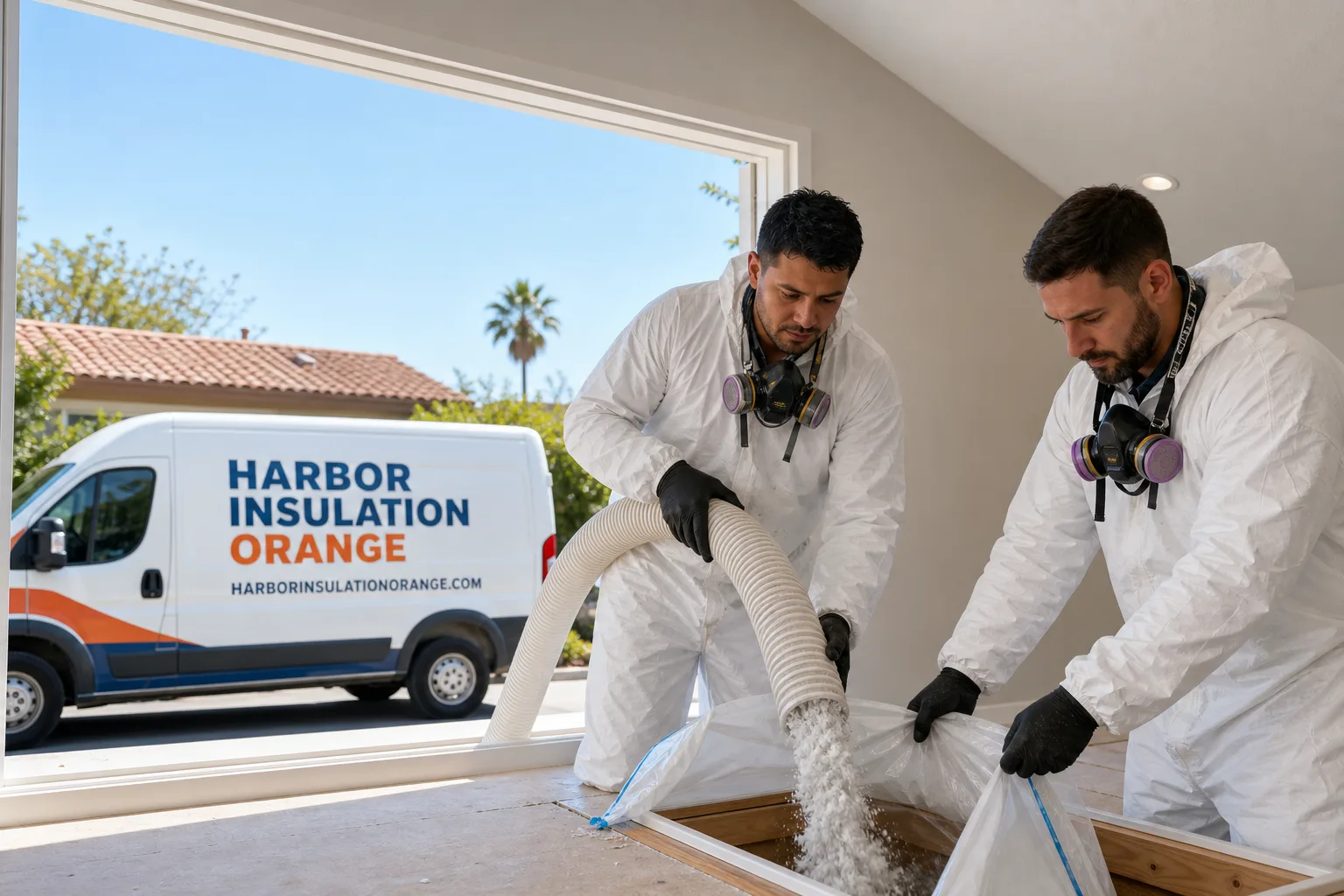
The difference isn’t our equipment or our materials, though those are top-tier. It’s that Noel Ibarra, the owner, is the person in the crawl space doing the work. Every time. When we quote a vapor barrier or full encapsulation in Brea, the same person who measured your foundation vents is the one seam-taping the liner and sealing the rim joists. No handoff to an unfamiliar crew, no “the sales guy said” confusion.
We work across Orange County but Brea occupies a specific spot in our service map. We know the tract layouts in the 92821 zip code, the hillside builds in Brea Hills, and the split-levels near Carbon Canyon that always seem to have two crawl spaces instead of one. That local familiarity means we arrive knowing what we’re likely to find before we even pull the access panel. And when you call about a musty smell in a 1970s two-story off Birch Street, we’re not scheduling a generic inspection. We’re showing up with the right material for that house.
Our Crawl Space Encapsulation & Vapor Barrier Services in Brea
Crawl Space Vapor Barrier
This is the foundation of everything we do in Brea. A vapor barrier is a heavy polyethylene liner laid across the dirt floor of your crawl space to stop soil moisture from migrating upward into your floor joists and subfloor. In Brea’s inland valley, the soil under pre-1985 homes holds moisture from decades of landscape irrigation, even during Santa Ana wind events when the air above is at single-digit humidity. We install 20-mil reinforced liners, seam-taped and sealed at every pier and penetration, because the thin 6-mil plastic builders used in the 1970s tears apart and curls within a few years.
Crawl Space Encapsulation
Encapsulation goes further: we seal the entire crawl space as a conditioned area. This means vapor barrier on the floor, foam board or spray foam on the foundation walls, sealing the access hatch, and typically adding a dehumidifier sized to the space. For Brea homes with original HVAC ducting running through the crawl space, encapsulation prevents the condensation that forms when cool ducts pass over damp air. That’s not a hypothetical here; we see rusted galvanized duct runs in Brea crawl spaces regularly.
Crawl Space Insulation
Most Brea homes built before 1985 have fiberglass batts in the crawl space ceiling that are doing nothing. They’ve absorbed moisture, sagged away from the subfloor, and the kraft facing is growing mold. We remove the failed insulation and replace it with R-19 or R-21 batts properly supported, or switch to closed-cell spray foam on the rim joists and foundation walls if you’re going the full encapsulation route. In Brea’s climate, where summer attic heat is the dominant energy load, a properly insulated crawl space keeps your floors from turning into slab radiators in July.
Crawl Space Moisture Control
Moisture control in Brea isn’t just about the vapor barrier. It’s about managing the wide day-night temperature swing this inland valley creates. Hot, dry Santa Ana air pushes into the crawl space during the day. At night, temperatures drop 30+ degrees, and any moisture in the exposed dirt condenses on the cool surfaces: joists, subfloor, the underside of the plastic itself. We address this with a combination of vapor barrier, foundation vent sealing, and where needed, a crawl space dehumidifier. For hillside homes near Carbon Canyon, we also handle ground water seepage from winter rains with drain matting and sump pump integration.
What happens when you call
- 1
A real person answersNo phone trees — you reach a local pro.
- 2
You get an upfront price rangeHonest numbers before anyone is dispatched.
- 3
A background-checked tech heads outLicensed & insured, dispatched right away.
- 4
You approve before work beginsNothing starts until you say go.
Trusted Brands We Service in Brea
We stock and install materials from Owens Corning, Johns Manville, and Knauf, and we pick the right product for the condition of your specific crawl space, not whatever’s left on the truck. For Brea’s pre-1985 tract homes, that usually means Owens Corning R-19 fiberglass batts for floor replacement work and Johns Manville polyiso or Knauf board for foundation wall insulation. We keep standard sizes on hand for Brea jobs, which means we don’t have to pause mid-installation waiting on a warehouse delivery from Anaheim or Fullerton.
Common Crawl Space Encapsulation & Vapor Barrier Problems We See in Brea Homes
- Dirt floors with no vapor barrier at all: Some 1960s Brea tract homes never had one installed, or it was a builder-grade 4-mil sheet that disintegrated before the Reagan administration ended. We regularly find bare dirt under entire bedrooms.
- Santa Ana wind-driven condensation: Brea’s exposure to dry, hot wind events sounds like it would dry out a crawl space, but the pressure differential actually pulls damp soil air upward into the floor cavity, where it condenses on cool joists at night.
- Sagging, moldy fiberglass batts: Original crawl space insulation in Brea’s 1962-1985 housing stock has almost universally failed. It’s waterlogged, falling onto the dirt, and the kraft paper facing is a mold farm.
- Unsealed access hatches and foundation vents: Most Brea homes have crawl space vents that were never designed for this climate. They let hot wind in during the day and cold air in at night, turning the crawl space into a condensation chamber.
Pricing for Crawl Space Encapsulation & Vapor Barrier in Brea, CA
- 20-mil vapor barrier install (floor only, including seam taping and pier sealing): $4,500 to $7,500
- Full encapsulation (vapor barrier + foundation wall insulation + access hatch seal): $8,000 to $14,000
- Encapsulation with dehumidifier and drainage improvements: $12,000 to $18,000
- Crawl space insulation replacement only (remove failed batts, install R-19): $2,800 to $5,500
What moves the number: square footage, crawl space height (a 24-inch crawl under a Carbon Canyon hillside build costs more in labor than a 40-inch space in a flat tract home), how much failed insulation has to be hauled out, and whether you need drainage work for winter seepage. We give you a written quote after Noel inspects the space himself. It’s free. Call (657) 530-5638 to schedule it.
We Also Serve Cities Near Brea
If you’re outside Brea but nearby, we handle full Crawl Space Encapsulation & Vapor Barrier work in La Habra, Placentia, Yorba Linda, and Villa Park. The housing stock in those cities shares the same era and construction type as Brea, so the problems are familiar to us. Whether you’re in a 1970s split-level in Placentia or a hillside build in Yorba Linda, the fix is the same: stop the soil moisture before it reaches your floors. See more about our work across the area at Crawl Space Encapsulation & Vapor Barrier in Brea.
Serving Brea, CA — Our Local Coverage Area
We’re based in the Brea area and know this community well. Use the map below to see our service coverage — if you’re nearby, we can almost certainly help.
FAQs — Crawl Space Encapsulation & Vapor Barrier in Brea
Code in the 1960s and 1970s allowed 4-mil or 6-mil polyethylene, and it was often installed poorly, with tears, gaps, and no seam sealing. Brea’s specific problem is the day-night temperature swing: hot Santa Ana days followed by 30-degree night drops create condensation pressure that shreds thin plastic within a few seasons. We install 20-mil reinforced liners because that’s what actually survives in this climate. Call (657) 530-5638 for an exact quote on your crawl space.
You can patch it, and if the original barrier is mostly intact and the exposed areas are small, that might buy you two or three years. But in most Brea homes we see, the original barrier is covering 60% of the floor at best, curled at the edges, and torn around every pier. Patching a deteriorated barrier is throwing money at a material that already failed once. We’ll give you an honest assessment. Estimates are free.
Yes, directly. The musty smell isn’t the dirt itself; it’s mold and bacteria feeding on moisture that wicks up from the soil and condenses on wood surfaces. Once we seal the floor with a 20-mil liner and address the rim joists, the moisture source is cut off and the smell dissipates. We’ve had Brea homeowners report the smell gone within a week. Call (657) 530-5638 and we’ll schedule the inspection.
It will, because your cooling load in Brea is driven by heat gain through the attic and heat transfer through the floor. A damp, unconditioned crawl space forces your HVAC to work harder maintaining temperature above it, especially when ductwork runs through the space and is absorbing heat from the soil. Encapsulation stabilizes the under-floor temperature and reduces the delta your system has to fight. For Brea’s inland summer heat, that shows up on the bill.
Hillside crawl spaces in Brea Hills and along Carbon Canyon can take on groundwater during heavy rain events. We install perimeter drain matting that channels water to a sump pit, then cover everything with the vapor barrier so the system is sealed. It’s a more involved job than flat-lot encapsulation, but it’s the only way to actually solve seepage rather than hiding it under plastic. Call (657) 530-5638 for a free quote. Noel will inspect the space and tell you exactly what’s needed.
Written by Noel Ibarra, Owner at Harbor Insulation Orange, serving Brea and greater Orange County with owner-installed crawl space encapsulation and vapor barrier work.