
How Much Does Insulation Removal & Replacement Cost in Orange?
Insulation removal and replacement in Orange, CA typically costs between $1,800 and $5,500 for a standard single-story home, with attic jobs in the 1,000–1,500 sq ft range landing most often in the $2,200–$3,800 window once removal, disposal, and new material are factored together. Crawl space work and wall cavity replacement can push that figure higher depending on access difficulty, contamination, and the replacement material chosen. Most Orange homeowners get a final number after a walk-through audit – not before – because the condition of what’s already up there changes the scope significantly.
Insulation Removal & Replacement Cost Breakdown (2026)
The table below reflects real pricing ranges we see on jobs in Orange and the surrounding areas of Orange County. These are not national averages pulled from a database – they’re drawn from the actual scope of work involved in pulling old material, cleaning the space, and installing new insulation to current California Title 24 standards.
| Scope of Work | Typical Range (Orange, CA) | Notes |
|---|---|---|
| Attic removal only (blown-in fiberglass or cellulose) | $800 – $1,400 | Vacuum extraction + bagging + disposal. Price scales with sq footage and depth of existing material. |
| Attic removal + blown-in fiberglass replacement (R-38) | $1,800 – $3,200 | Most common request in Orange homes built 1970s–1990s. Includes new Owens Corning or Johns Manville blown fiberglass. |
| Attic removal + blown-in cellulose replacement (R-38) | $1,700 – $3,000 | GreenFiber recycled cellulose. Slightly lower material cost; performs well in Orange’s dry climate. |
| Attic removal + spray foam replacement (open-cell) | $3,200 – $5,500 | Icynene or Demilec open-cell foam applied to roof deck. Best when combining air sealing into one step. |
| Attic removal + batts replacement (fiberglass or mineral wool) | $1,900 – $3,400 | Knauf, CertainTeed, or Rockwool batts. Better for attics with knee walls or finished sections. |
| Crawl space removal + vapor barrier + replacement | $2,400 – $5,000+ | Highly variable. Tight clearance, moisture damage, or rodent contamination all add cost. |
| Wall cavity removal + replacement (per room or partial) | $1,200 – $4,000+ | Depends heavily on access method (drill-and-fill vs. drywall open). Most common in older Orange neighborhoods like Old Towne. |
| Attic cleaning & rodent proofing (add-on or standalone) | $600 – $1,500 | Sanitation, decontamination of soiled material, and entry-point sealing before new insulation goes in. |
| Air sealing (added to removal/replacement project) | $400 – $900 | Sealing top plates, recessed lights, and penetrations before new insulation. Frequently missed by one-visit contractors. |
A few things push that total higher in Orange specifically. Older homes in the Villa Park border area and around Santiago Hills often have multiple layers of degraded insulation stacked over decades – original batts under a blown-in top layer from the 1990s – which means more material to extract and a higher disposal cost. Homes built before 1980 occasionally still have kraft-faced batts stapled to joists that have to be pulled by hand rather than vacuumed, which is slower work. On the lower end, a straightforward attic-only job on a newer tract home near the 55 freeway corridor with clean, single-layer blown-in is the simplest scope we handle.
Air sealing is worth calling out separately because it’s almost always worth adding to a removal and replacement job. Doing it mid-project – after the old material is out and before new insulation goes in – costs a fraction of what it costs to treat as a standalone visit later. We include it as part of the Insulation Removal & Replacement in Orange conversation every time.
What Affects Insulation Removal & Replacement Pricing in Orange
- Attic height and access difficulty. Orange has a wide mix of home styles, from single-story ranch homes with low-pitched rooflines in the Serrano Heights area to older two-story colonials near Old Towne with cramped knee walls and split-level attic sections. When our lead installer can’t stand upright or has to work around HVAC ducts and cross-bracing, the job takes longer – and that’s reflected in the price honestly rather than padded in a surprise invoice.
- Existing insulation condition and contamination. Clean, dry material that can be vacuum-extracted is the easiest scenario. Wet, compressed, or rodent-contaminated insulation – which we see fairly regularly in older homes near the Santa Ana River bottom – requires bagging, sanitizing, and sometimes decontamination before new material goes in. Biohazard disposal fees are real and separate from standard landfill costs in Orange County.
- Replacement material type. Blown-in fiberglass from Owens Corning or Johns Manville and GreenFiber cellulose are the most cost-efficient options for attic replacement. Rockwool and Demilec or Icynene spray foam sit at the higher end – and for good reason. Spray foam doubles as an air barrier. Rockwool boards add fire resistance. The right material depends on your home’s construction and goals, which is why we start with a home energy audit before recommending anything.
- Square footage and R-value depth required. California’s Title 24 code requires R-38 minimum in attics for most Orange-area homes undergoing permitted work. If you’re pushing to R-49 or R-60 for maximum performance – which some homeowners do when they’re chasing serious energy bill reductions – the material cost increases proportionally. More material, more time, higher total.
- Crawl space clearance and moisture history. Homes in the low-lying sections of Orange near the 22 freeway corridor can have crawl spaces with limited clearance and occasional seasonal moisture intrusion. That combination means the removal work is slower, vapor barriers are typically required before new insulation goes down, and encapsulation should be on the table. Skipping the moisture side of the equation and just reinstalling new batts in a damp crawl space is a short-term fix that we won’t do.
- Permit requirements. Certain replacement scopes in Orange trigger a City of Orange building permit, particularly when the work involves attached garages, fire-rated assemblies, or spray foam at the roof deck. Permit fees in Orange typically run $150 – $400 depending on valuation. We handle the paperwork and inspection coordination – it’s not an excuse to skip a permit, and we won’t suggest it is.
How to Save on Insulation Removal & Replacement in Orange
The biggest money wasted in insulation replacement is paying for the right material in the wrong application – or worse, skipping removal entirely and blowing new product over old, failing insulation. Neither shortcut actually solves the problem, and in Orange’s climate, where summer attic temperatures regularly hit 140°F to 160°F, poor-performing insulation costs you money every month it stays in place.
Here’s where the real savings are:
- Audit before you commit. A home energy audit tells you exactly where the thermal losses are. Sometimes the attic isn’t the main problem – it’s air leakage through top plates or a crawl space without a vapor barrier. Spending $3,000 on new attic insulation when the real issue is a drafty crawl space doesn’t fix the energy bill. We audit before we recommend, which means you’re paying for what will actually work.
- Bundle air sealing into the removal project. When the attic is clear – old insulation out, joists exposed – it costs significantly less to seal penetrations, recessed lights, and top plates than it does to come back for a second visit. On a typical Orange attic job, adding air sealing during the removal phase runs $400 – $900. Doing it as a separate project later often costs $800 – $1,500 because of the mobilization cost and the challenge of working around existing insulation.
- Don’t over-specify the material without a reason. Spray foam is excellent in the right application – closed-cell foam on the roof deck of an older home can be the right call. But if your attic is well-sealed and you just need new thermal mass, blown-in fiberglass or GreenFiber cellulose will perform beautifully at a lower cost. We stock eight brands and can recommend the right one for your specific situation rather than defaulting to whatever carries the highest margin.
- Check for California and SCE/SoCalGas rebates. Southern California Edison and SoCalGas both run insulation upgrade rebates that apply to Orange homeowners. The exact amounts change annually, but attic insulation upgrades that bring a home to Title 24 compliance or above have historically qualified for $0.10 – $0.20 per square foot in rebates through utility programs. Our home energy audit documentation can support rebate applications. We’ll tell you what’s available when we assess the job.
- Get an accurate scope – not a low-ball quote. A quote that excludes disposal, doesn’t account for existing contamination, or ignores air sealing will look cheaper on paper and cost more when the add-ons hit mid-job. When you call us, the estimate accounts for the full scope – removal, disposal, any cleaning or decontamination required, and installation of new material. No surprise line items after we’ve started work.
Call (657) 530-5638 to schedule a free estimate. The owner does the walk-through personally – the same person who’ll do the installation – so what gets quoted is what gets done.
What the Removal Process Actually Involves
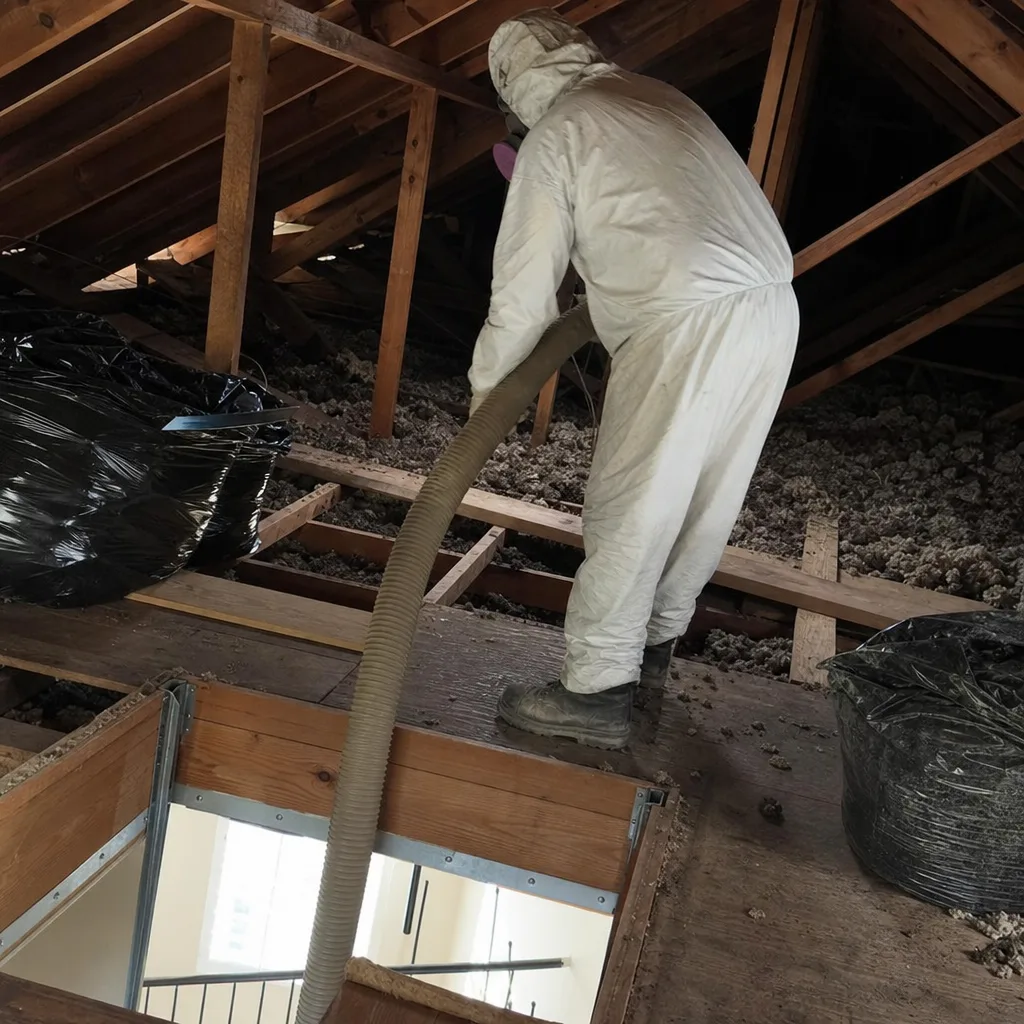
A lot of homeowners don’t fully understand what they’re paying for in the removal phase, so let’s be specific about it. Blown-in attic insulation – the loose-fill fiberglass or cellulose most Orange homes from the 1980s and 1990s have – gets extracted using a high-powered vacuum system fed through a hose into the attic space. The material gets collected in large bags, hauled out through the access hatch, and disposed of at an approved facility. A 1,200 sq ft attic with 10 inches of old material generates a significant volume of waste – typically 20 to 40 bags depending on material density.
After extraction, we inspect what’s underneath: the condition of the ceiling joists, any signs of moisture staining, the state of HVAC boots and penetrations, the quality of existing vapor retarders on batts if any were present. This is the point in a job where problems get found – and where a contractor who was in a hurry to get to the next job might skip past things that matter. We do the visual inspection every time because it directly affects what we recommend for the reinstall.
If rodent activity is present – droppings, nesting material, or soiled insulation from urine – the decontamination step comes before new material goes in. That means sanitizing exposed surfaces and, usually, sealing any confirmed or suspected entry points as part of the rodent proofing work. Installing new insulation over an active or recent rodent problem is something we won’t do because it guarantees the customer is calling someone in 18 months with the same issue.
For batt insulation in crawl spaces, the process is different – it’s manual removal of faced batts that have often been held up by wire supports or stapled to joists, collected, bagged, and hauled. Crawl space work in Orange is slower due to access constraints, especially in homes with pier-and-beam construction where the clearance under the floor system can be as little as 18 to 24 inches. That’s a hard physical constraint that affects labor hours directly.
Replacement Material Options and Their Real-World Performance in Orange
Orange sits in Southern California’s inland coastal zone – warm and dry most of the year, with summer heat that’s less extreme than the Inland Empire but still punishing for a home with poor attic insulation. The dominant challenge is heat gain through the roof assembly, not cold-weather heat loss. That climate context matters when choosing replacement material.
Blown-In Fiberglass (Owens Corning, Johns Manville, Knauf)
The most common replacement in Orange attics. Blown fiberglass settles less than cellulose, doesn’t absorb moisture readily, and installs quickly to consistent depth. At R-38 to R-49, it handles Orange’s climate well. Owens Corning’s AttiCat system and Johns Manville’s Spider product are two we use regularly. Knauf’s EcoBatt blown product is another solid performer. These aren’t interchangeable in all applications – the density and coverage specs differ, and we match the product to the attic geometry.
Blown-In Cellulose (GreenFiber)
GreenFiber recycled cellulose is dense-pack capable, which makes it useful for wall cavities where we need to fill existing stud bays without opening drywall. In attics, it provides excellent coverage at a slightly lower material cost than fiberglass. It does absorb some moisture when wet – something to be aware of in the rare Orange rain event or if there’s any roof leak history – so the substrate has to be dry before it goes in.
Spray Foam (Icynene, Demilec)
Both Icynene and Demilec offer open-cell and closed-cell formulations. In Orange attics, open-cell foam applied to the underside of the roof deck creates an unvented, conditioned attic that performs very differently from a vented attic with blown-in insulation. It’s a bigger upfront investment but eliminates the gap between the thermal envelope and the HVAC equipment when ductwork runs through the attic space – which is the situation in most Orange tract homes. When ducts are in the attic and they’re losing conditioned air to an unconditioned space, spray foam at the deck can pay for itself in three to five years in energy savings.
Closed-cell foam from Demilec is the right call for crawl space applications where moisture resistance is a requirement and vapor barrier function is needed in a single material.
Batts (Rockwool, CertainTeed, Knauf)
Rockwool (mineral wool) batts offer fire resistance and acoustic performance that fiberglass doesn’t match – a consideration for shared walls and homes near the 57 or 55 freeway corridors in Orange where exterior noise is a factor. CertainTeed’s ProBatt and Knauf’s EcoBatt products are strong performers for attic floors and wall cavities where batt installation is the right format. We use batts where they make sense and blown-in where they make more sense – not one-size-fits-all.
When Replacement Is the Right Call (Not Just a Patch)
Some homeowners ask whether they can just add new insulation on top of existing material without removing it first. The honest answer: sometimes yes, sometimes absolutely not.
Adding blown-in product over existing blown-in that is dry, uncontaminated, and still at or near its original loft is sometimes reasonable – we evaluate this case by case. But in Orange, we see a number of situations where removal is not optional:
- Rodent activity, droppings, or nesting. New material on top of biohazard material is not acceptable and defeats the purpose of the work.
- Moisture damage or mold. Wet, compressed insulation has near-zero R-value and introduces a mold substrate. It has to come out.
- Contamination from a roof leak. Even if the leak is repaired, the saturated material below needs to be removed and the sheathing inspected.
- Old vermiculite insulation (found in some Orange homes built before 1978). This requires specific handling protocols and testing before any work proceeds.
- Batt insulation that has fallen, shifted, or been disturbed by HVAC service. Rebridging gaps with blown-in product over misaligned batts doesn’t restore the performance – removal and reinstall is the right approach.
From our home base in Orange, we handle the full scope on every job – not just the new install, because that’s the part that’s easiest to charge for. The removal, the inspection, the cleaning, the air sealing: that’s where the job is actually done right.
FAQs – Insulation Removal & Replacement Cost in Orange
How much does attic insulation removal cost in Orange, CA?
Attic insulation removal in Orange typically costs $800 to $1,400 as a standalone service for a 1,000–1,500 sq ft attic, including vacuum extraction, bagging, and disposal. Homes with multiple layers, contamination, or difficult access will land toward the higher end. That removal cost is usually folded into the full project price when we’re doing removal and replacement together through our Insulation Removal & Replacement services, which is the more cost-efficient way to approach it. Call (657) 530-5638 for a free estimate based on your specific attic.
Is it cheaper to repair insulation or replace it?
In most cases we evaluate in Orange, replacement is the better investment – not because we sell more material that way, but because patching failing insulation rarely restores full R-value. If the existing insulation is contaminated, moisture-damaged, or severely settled, the patch costs money without fixing the problem. If the material is still in reasonable shape with isolated gaps, we’ll tell you that too – we start with an audit, not a sales pitch. A repair, when it’s appropriate, might run $300 to $700 for localized remediation versus $2,000+ for full replacement.
Does replacing insulation lower energy bills in Orange?
Yes, and in Orange’s climate the impact is most visible in summer. Homes with degraded attic insulation – particularly those with R-values below R-19 or compressed material that’s no longer performing at spec – can see 15% to 30% reductions in cooling costs after proper removal and replacement to R-38 or higher. The specific savings depend on your HVAC system, duct condition, and how well the air sealing is addressed alongside the insulation. We include air sealing as part of the conversation on every project for exactly this reason.
How long does insulation removal and replacement take in Orange?
A typical attic removal and replacement on an Orange home runs one full day for most single-story homes in the 1,000–1,600 sq ft range – removal in the morning, inspection and air sealing in the afternoon, new material installed before we leave. Larger homes, two-story layouts with complex attic sections, or jobs that include crawl space work may take two days. Spray foam applications have cure time requirements that affect the schedule. We give you a realistic timeline upfront – the owner is the one doing the work, so there’s no crew coordination delay built into the schedule.
Do I need a permit for insulation removal and replacement in Orange, CA?
It depends on the scope. Standard attic blown-in replacement to existing R-values typically does not require a City of Orange building permit. Projects that involve spray foam at the roof deck, changes to fire-rated assemblies, or work in attached garages often do require a permit, with typical fees running $150 to $400. We pull the permit when it’s required – it’s not a gray area we try to work around. If your project needs one, we’ll tell you upfront and include it in the scope discussion. Call (657) 530-5638 and we’ll walk through your specific situation.
Key Takeaways
- Insulation removal and replacement in Orange, CA runs $1,800 to $5,500 for most residential jobs, with the majority of attic projects landing in the $2,200 – $3,800 range.
- Removal costs $800 – $1,400 on its own; it’s more cost-effective when bundled into a full replacement project.
- Air sealing added during removal costs $400 – $900 and should not be skipped – it’s where a significant portion of energy loss originates.
- Contamination, crawl space access difficulty, and permit requirements are the three most common cost variables that surprise Orange homeowners on jobs that were initially quoted without a proper walk-through.
- Material choice – from GreenFiber cellulose to Icynene spray foam – should follow an audit, not a default recommendation.
- California utility rebates through SCE and SoCalGas may offset a portion of the project cost for qualifying upgrades.
Pricing reflects the Orange market as of 2026. Harbor Insulation Orange offers free estimates – call (657) 530-5638.
Written by the Owner & Lead Installer at Harbor Insulation Orange, serving Orange, CA.
What Our Customers Say
"Work is good and the house is noticeably more comfortable. There was insulation debris left in the hall closet under the attic access that I had to clean up."
— Norma Flores"Plastic laid from the front door to the attic hatch and they vacuumed the hallway afterward."
— Vikram Sharma"Found and sealed a gap around the chimney chase that was basically an open chimney to the attic."
— Gabriela Reyes