
How Much Does Attic Air Sealing Cost in Orange, CA?
Attic Air Sealing services in Orange, CA typically cost between $800 and $2,500 for a standard single-family home, with most Orange homeowners landing between $1,000 and $1,800 depending on attic size, accessibility, and how many penetration points need to be sealed. If you’re combining air sealing with new insulation installation in the same visit, the per-job cost often drops because the labor is already up there. Most jobs in Orange are completed in a single day.
Attic Air Sealing Cost Breakdown (2026)
Attic air sealing in Orange, CA typically costs between $800 and $2,500 for most single-family homes. The majority of jobs we complete in Orange fall in the $1,000 to $1,800 range. Here’s how the numbers typically stack up by scope:
| Scope / Job Type | Typical Cost Range (Orange, CA) |
|---|---|
| Small attic, under 1,000 sq ft (limited penetrations) | $800 – $1,100 |
| Mid-size attic, 1,000 – 1,600 sq ft (typical Orange ranch or tract home) | $1,100 – $1,600 |
| Larger attic, 1,600 – 2,200 sq ft (two-story or larger single-family) | $1,500 – $2,000 |
| Complex attic with HVAC penetrations, recessed lights, dropped soffits | $1,800 – $2,500+ |
| Air sealing bundled with attic insulation install | Add $600 – $1,200 to insulation job (less than standalone) |
| Air sealing only, no insulation work | $800 – $1,600 depending on penetration count |
| Home Energy Audit (before air sealing is recommended) | Quoted separately – call (657) 530-5638 for current pricing |
These ranges reflect what Harbor Insulation Orange actually quotes in the Orange market in 2026, not national averages pulled from generic cost databases. Orange’s housing stock skews heavily toward 1,960s – 1,990s tract construction in neighborhoods like El Modena, Serrano Heights, and Friendly Hills, which means we see a repeating set of attic conditions: original fiberglass batts loosely placed between joists, recessed can lights that weren’t sealed at install, and HVAC ducts that pass through the thermal boundary without proper air stops. Those penetrations are where conditioned air actually escapes, and sealing them is where you see the real return.
A few things that push a job toward the higher end: very low attic clearance (anything under 24 inches makes maneuvering slow and careful work even slower), existing insulation that has to be pulled back and reset around each penetration, or a home that’s had multiple HVAC upgrades over the decades, each one adding new holes in the drywall ceiling without sealing the old ones. Homes in the foothills near Santiago Canyon Road sometimes have unconventional framing from custom builds that adds time. None of these are problems we walk away from – they just affect where your number lands.
What Affects Attic Air Sealing Pricing in Orange
Six factors consistently move the price up or down on Orange attic air sealing jobs. We track all of these during our initial assessment before quoting anything.
- Attic square footage and height: Larger attics simply have more linear feet of top plate and more ceiling penetrations to address. Low-clearance attics – common in older Spanish-style and ranch homes in West Orange and the Villa Park border area – slow the work down because every move has to be deliberate. More time means higher cost.
- Number and type of penetrations: Every recessed light, HVAC boot, plumbing chase, interior partition wall top plate, and electrical wire hole is a potential air leak. A 1,400 sq ft attic in a 1970s El Modena home might have 40-60 individual penetration points. A newer home in the Serrano Heights development might have a third of that because it was built under tighter code. More penetrations equal more material and more labor.
- Type of sealing material required: Most attic air sealing uses one-part expanding spray foam and fire-rated caulk for standard penetrations. Larger gaps around chases, dropped soffits, and HVAC platforms often require rigid foam board cut to fit and then foamed at the edges, which adds material cost. We use materials from our stocked brands – nothing substituted mid-job based on what’s available.
- Existing insulation condition: If your existing insulation needs to be moved out of the way to reach the top plate and then reset afterward, that’s additional labor. If the insulation is contaminated or rodent-damaged, it needs to come out entirely before air sealing – which is a separate scope. We handle both, but they’re quoted separately so you know exactly what you’re paying for each phase. Our Attic Air Sealing in Orange service page covers how we approach that sequencing.
- HVAC and ductwork configuration: Homes in Orange with attic air handlers or older duct systems often have oversized platform openings cut into the ceiling that were never properly air-stopped. Sealing around an air handler platform takes more material and care than sealing a wire penetration. If your HVAC is original to a 1980s or 1990s build, this is almost always part of the picture.
- Bundled vs. standalone scope: When we’re already up in the attic for an insulation install or replacement, adding air sealing to that visit costs less per job than scheduling it as a standalone service. The setup time, site prep, and cleanup are shared across the work. If you’re planning any attic work at all, it’s worth asking about combining scopes.
Why Orange Homes Leak More Air Than You’d Expect
Orange sits in a climate zone where the temperature swing between a January night and a July afternoon can exceed 50 degrees Fahrenheit. Most national content about attic air sealing frames the problem as a winter-only concern – cold air infiltrating from outside. In Orange, the problem runs in both directions. During summer, attic temperatures routinely reach 140-160 degrees in unventilated or poorly sealed spaces. That heat drives into living areas not just through the insulation, but through every gap and penetration in the attic floor.
We see this play out specifically in the neighborhoods that experience Santa Ana wind events. When offshore winds drive hot, dry air through the region – which happens multiple times per year in Orange – a poorly air-sealed attic effectively acts as a bellows, pulling that hot air through every gap. Homeowners in the foothills near Nohl Canyon Road and Katella Avenue often notice it first as a sudden spike in indoor temperature that their HVAC can’t recover from until the winds die down. That’s not just an insulation problem. That’s an air sealing problem.
Older homes in the historic downtown core near Chapman Avenue also have a specific issue: original plaster-and-lath ceilings that were retrofitted with drywall at some point, creating a layered ceiling assembly with significant air movement pathways built into the structure. Air sealing in those attics takes longer and requires more material, which is why we always start with a proper assessment before quoting.
None of this means your house is unusually bad. It means the architecture and climate of Orange, CA create conditions where attic air sealing delivers a measurable payoff – not just in comfort, but in what you pay to cool and heat the home year after year. Homes that have gone through proper home energy audit and air sealing work at Harbor Insulation Orange have seen meaningful reductions in HVAC runtime, which shows up in utility bills.
How to Save on Attic Air Sealing in Orange
There are a few legitimate ways to reduce the cost of attic air sealing without cutting corners on the work itself.
Bundle air sealing with insulation work
The single most consistent way to reduce your per-job cost is to schedule air sealing at the same time as insulation installation or replacement. When we’re already set up in the attic with protection in place and the access open, adding air sealing to the scope adds material cost but minimal additional setup time. Homeowners who try to do these as two separate jobs pay for two separate mobilizations. Combine them and you’re ahead financially even if the combined invoice looks higher.
Get a Home Energy Audit first
We audit before we recommend – that’s not a sales pitch, it’s how the work gets done right. A Home Energy Audit identifies exactly which penetrations are leaking and how severely, which means you’re not paying to seal gaps that aren’t contributing to your energy loss. Without a diagnostic, some contractors will simply seal everything they can reach, which sounds thorough but isn’t always the most efficient use of your budget. Knowing where the real losses are keeps the scope focused.
Ask about California utility rebates and state programs
Southern California Edison and SoCalGas both periodically offer rebate programs for energy efficiency work, and attic air sealing has qualified for rebate dollars under various program cycles. The availability and amounts change year to year, but in 2025 and into 2026, weatherization programs have remained active in Orange County. We can point you toward the current program details during your estimate appointment, though you’ll want to verify directly with the utility for the most current figures.
Address attic access issues before we arrive
If your attic hatch is in a closet packed floor to ceiling, or if there’s furniture directly below the access panel, clearing that before we arrive saves time on site. It’s a small thing, but on a job where labor hours drive cost, every bit of setup efficiency helps.
Don’t wait until the problem is compounded
Air sealing costs stay relatively stable. But postponing the work while you have an active rodent issue, a roof leak, or degraded insulation means those problems will expand the scope when you eventually address everything. A clean, dry attic with intact insulation is the cheapest version of this job. Waiting makes it more expensive, not less.
Call (657) 530-5638 for a free estimate. We’ll give you a number specific to your home’s attic – not a range from a price calculator.
What the Work Actually Involves
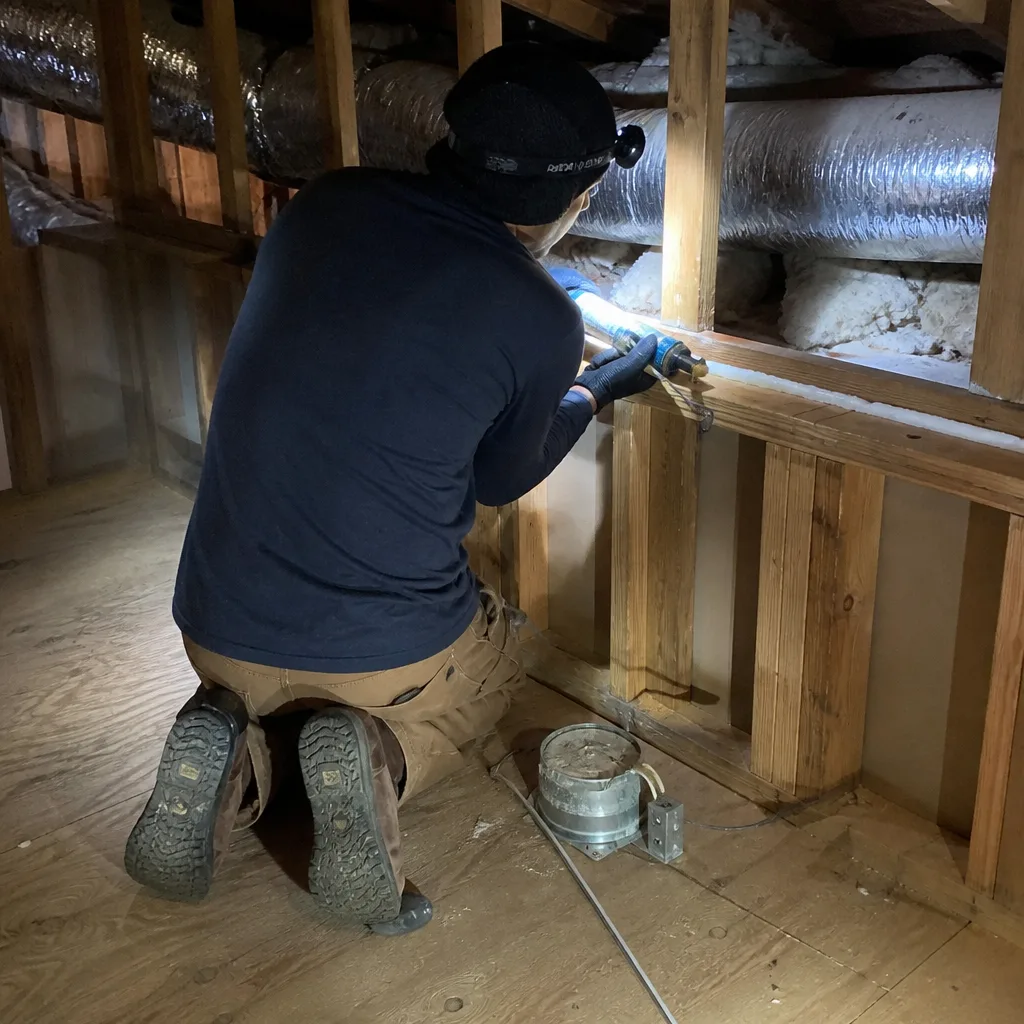
A lot of homeowners are surprised by how physical and specific attic air sealing actually is. It’s not a quick spray-and-go job. On a typical Orange home, the work involves:
- Moving or pulling back existing insulation to expose the top plate and ceiling assembly around the perimeter and at all penetration points
- Identifying and marking every penetration: recessed lights, electrical boxes, plumbing chases, HVAC boots, exhaust fans, interior partition walls, and attic access hatches
- Sealing small gaps (under 1/4 inch) with fire-rated acoustic caulk or paintable latex caulk depending on the substrate
- Sealing medium gaps (1/4 inch to 3 inches) with one-part expanding spray foam, trimmed flush after cure
- Fabricating rigid foam caps or dams for larger openings around HVAC platforms, dropped soffits, or open-web truss cavities, then foaming the perimeter seal
- Air-sealing the attic hatch itself – often overlooked and one of the largest single leakage points in an older Orange home
- Resetting insulation after sealing is complete
At Harbor Insulation Orange, the owner installs it – every time. The person on the phone quoting your job is the same person crawling through your attic with the foam gun. That matters for a task like this because the decisions made on the fly – which product to use on a particular gap, how to handle an unusual framing condition, whether a penetration needs foam or caulk or a fabricated cap – require judgment that comes from doing the work repeatedly, not from following a checklist handed down by a project manager.
We stock materials from eight manufacturers: Owens Corning, Johns Manville, Knauf, Rockwool, CertainTeed, Icynene, Demilec, and GreenFiber. For air sealing specifically, the spray foam products we use come from our Icynene and Demilec lines – two of the most consistent performers in this application. The sealing material isn’t chosen based on what’s cheapest at the supply house that week.
Air Sealing vs. Adding More Insulation: Which Comes First?
This comes up constantly in Orange. A homeowner gets a quote for adding blown-in insulation to bring R-value up to current Title 24 standards, and the question is whether to also do air sealing, and in what order.
The correct answer is: air sealing first, then insulation on top. Here’s why it matters. Insulation slows the transfer of heat through conduction. Air sealing stops the movement of air – which carries heat (and moisture, and allergens) through gaps and penetrations regardless of how much insulation is present. You can have R-38 blown-in cellulose sitting on top of a ceiling with 60 unsealed penetrations and still have a home that feels drafty and costs too much to cool. The insulation is doing its job; the air movement is bypassing it entirely.
Installing insulation first and then trying to air seal underneath it is technically possible but significantly harder – you’d be pulling back insulation to access the penetrations, doing the sealing, and then resetting or adding back the insulation. It’s more labor and more cost. Do it in the right order and the job is cleaner, faster, and more effective.
If you already have insulation in place and it’s in acceptable condition, we can work around it – and we do this regularly. But if you’re starting from scratch or replacing degraded insulation, the sequence matters.
FAQs: Attic Air Sealing Cost in Orange, CA
How much does attic air sealing cost in Orange, CA?
Most Orange homeowners pay between $1,000 and $1,800 for a standard attic air sealing job, with smaller or simpler attics starting around $800 and complex jobs with many penetrations or low clearance reaching $2,500. The exact number depends on your attic’s square footage, how many penetration points need sealing, and whether you’re bundling the work with insulation. Call (657) 530-5638 for a free estimate specific to your home.
Is attic air sealing worth it in Orange’s climate?
Yes, measurably so. Orange’s summer attic temperatures regularly hit 140-160 degrees, and that heat moves into living areas through unsealed penetrations regardless of how much insulation you have. Properly sealed attics reduce HVAC runtime and can cut cooling costs significantly during peak summer months and Santa Ana wind events. Most homeowners see the investment recover within a few years in reduced utility costs – the actual timeline depends on your current leakage rate and utility rates, which vary.
How long does attic air sealing take in a typical Orange home?
A standard Orange ranch or tract home – roughly 1,200 to 1,600 square feet of attic space – typically takes 4 to 8 hours for a thorough air sealing job. Larger homes or those with complex HVAC configurations, low clearance, or significant penetration counts can run a full day. We don’t rush it. Every gap that gets missed is one we’d have to go back for.
Can I combine attic air sealing with insulation work to save money?
Yes, and we recommend it. When air sealing is done in the same visit as insulation installation or replacement, the combined job costs less than scheduling both separately. The setup and cleanup are shared, and the sequencing is already correct – seal first, then insulate on top. If you’re planning any attic insulation work, ask about adding air sealing to the same scope when you call (657) 530-5638.
Do I need a Home Energy Audit before getting attic air sealing?
An audit isn’t strictly required, but it makes the air sealing work significantly more targeted and cost-effective. A blower door test and thermal inspection identify exactly where your attic is leaking and how severely – so we’re sealing the gaps that actually matter, not just every visible penetration. We audit before we recommend, and for homeowners who want to know exactly what they’re paying for and why, the audit is the right starting point. Ask about our Home Energy Audit pricing when you call.
Are there rebates available for attic air sealing in Orange, CA?
Yes, rebate programs through Southern California Edison and SoCalGas have historically covered weatherization work including air sealing, though program terms and dollar amounts change regularly. As of 2026, energy efficiency programs remain active in Orange County, but you’ll want to verify current eligibility directly with your utility. We can walk you through what we know during your estimate appointment – call (657) 530-5638 to schedule.
Key Takeaways
- Attic air sealing in Orange, CA costs $800 to $2,500, with most jobs landing between $1,000 and $1,800.
- Orange’s summer heat and Santa Ana wind conditions make air sealing a high-return investment – more so than in mild climates.
- Older housing stock in El Modena, Friendly Hills, and West Orange typically has more penetrations and lower attic clearance, which affects pricing.
- Bundle air sealing with insulation work to reduce total cost; always seal before adding new insulation.
- A Home Energy Audit keeps the scope focused – you’re fixing what’s actually leaking, not guessing.
- At Harbor Insulation Orange, the owner installs the work directly – no rotating subcontractors, no handoffs.
- Call (657) 530-5638 for a free, no-pressure estimate specific to your home’s attic.
Get a Free Attic Air Sealing Estimate in Orange
If your energy bills are running high, your HVAC is working too hard, or you’re noticing rooms in your Orange home that never quite reach the right temperature, the attic is the first place to look. Air sealing is usually the fix that makes everything else work better – including the insulation you may already have.
Harbor Insulation Orange serves homeowners throughout Orange, CA with a diagnostic-first approach: we assess before we recommend, and the owner performs the installation directly on every job. There’s no bait-and-switch on materials, no crew you’ve never met showing up at your door, and no vague estimates that balloon when the work starts.
Call (657) 530-5638 to schedule your free estimate. We’ll take a look at your attic, tell you what we’re seeing, and give you a specific number – not a range from a calculator.
Pricing reflects the Orange, CA market as of 2026. Harbor Insulation Orange offers free estimates – call (657) 530-5638.
Written by the Owner & Lead Installer at Harbor Insulation Orange, serving Orange, CA.
What Our Customers Say
"Attic was at maybe R-11 from the 1970s and blown in over the top would have just buried the problem. They removed the old material, air sealed the top plates and penetrations first, then blew in to R-49. The upstairs is a completely different house in August."
— Dina Haddad"Told me the crawlspace didn't need doing and only the attic did. Half the job, half the money."
— Megan Thompson"Work is good and the house is noticeably more comfortable. There was insulation debris left in the hall closet under the attic access that I had to clean up."
— Norma Flores