
How Much Does Attic Insulation Cost in Orange, CA?
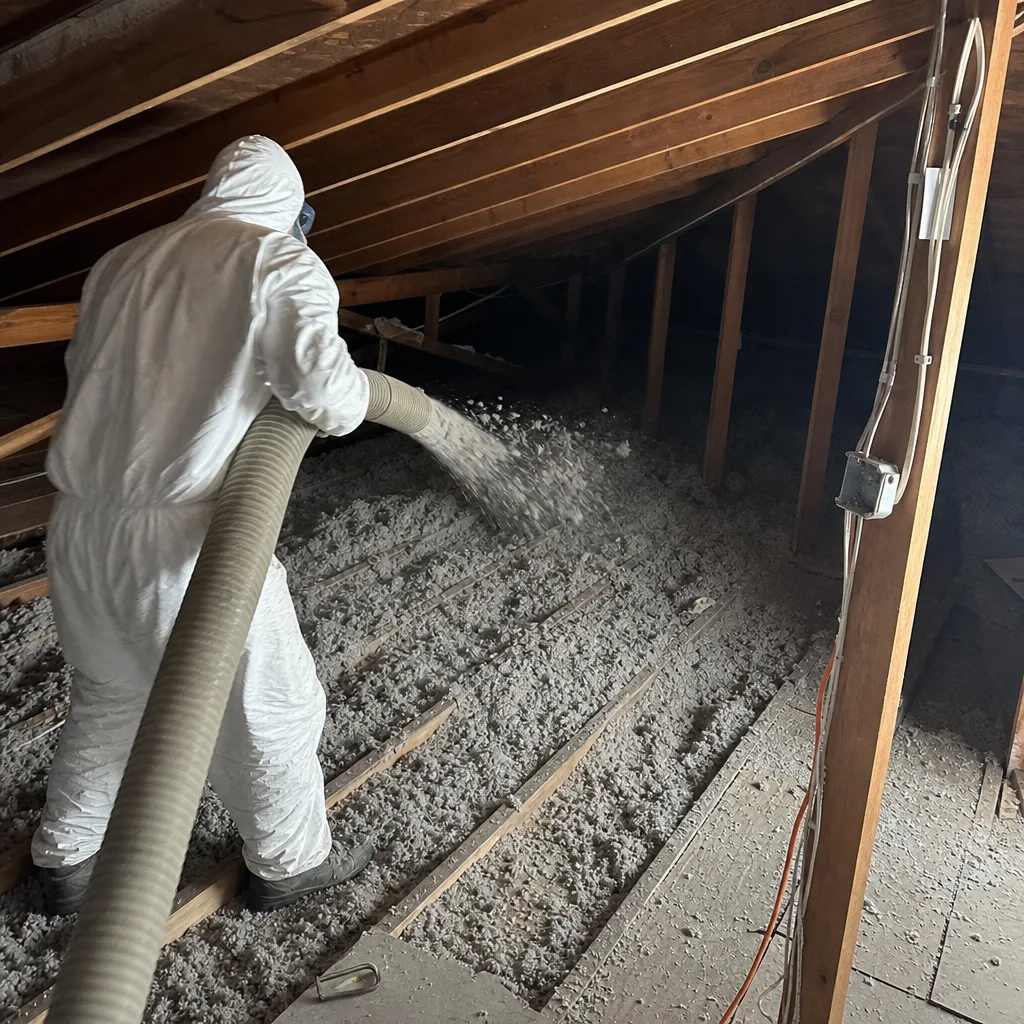
Attic Insulation Near Me in Orange, CA typically costs between $1,800 and $5,500 for a full installation, with most single-family homes landing in the $2,200 to $3,800 range depending on attic size, material choice, and whether old insulation needs to come out first. Blown-in fiberglass or cellulose runs lower; open-cell and closed-cell spray foam push toward the top end. If your attic is uninsulated or severely degraded, budget for the higher end of that range — and if you’re in an older neighborhood like Friendly Hills or Old Towne Orange, there’s a good chance aged insulation or pest damage has to be addressed before anything new goes in.
Attic Insulation Cost Breakdown for Orange, CA (2026)
Below are real price ranges for the Orange market. These reflect material costs, labor, and standard preparation work for a 1,200 to 1,800 square foot attic — the most common attic footprint in Orange’s tract and custom-home neighborhoods. Homes in larger areas like Serrano Heights or Santiago Canyon estates will see higher totals, but the per-square-foot math holds.
| Service / Material | Typical Cost Range | Notes |
|---|---|---|
| Blown-In Fiberglass (new install) | $1,800 – $2,800 | Owens Corning or Johns Manville product; ideal for uncomplicated open attics |
| Blown-In Cellulose (new install) | $1,700 – $2,600 | GreenFiber cellulose; good thermal and acoustic performance, recycled content |
| Fiberglass Batt (new install) | $1,500 – $2,400 | Knauf or CertainTeed product; cost-effective when attic framing is clean and accessible |
| Open-Cell Spray Foam | $2,800 – $4,200 | Icynene open-cell; strong air-sealing and sound control, lower R-value per inch than closed-cell |
| Closed-Cell Spray Foam | $3,800 – $5,500 | Demilec or Icynene closed-cell; maximum R-value and moisture resistance, right for cathedral ceilings |
| Rockwool / Mineral Wool Batt | $2,200 – $3,400 | Fire-resistant and dimensionally stable; preferred in fire-risk zones near the hills |
| Radiant Barrier (foil, attic deck) | $600 – $1,400 | Often paired with blown-in; can cut cooling loads significantly in Orange’s summer profile |
| Attic Air Sealing (before insulation) | $400 – $900 | Sealing top-plates, penetrations, and can lights before insulating; often doubles efficiency gains |
| Insulation Removal (existing degraded material) | $1,000 – $2,200 | Vacuum extraction, bagging, haul-off; required when old fiberglass is compressed, wet, or contaminated |
| Full Removal + Reinstall (complete lifecycle) | $3,200 – $6,500+ | Includes removal, attic cleaning, new material installation; common in homes 20+ years old |
These ranges assume standard attic access and no major structural obstacles. If your attic has knee walls, multiple HVAC systems running through it, or limited hatch access – common in some of the 1960s ranch-style homes around the El Modena and Olive areas – labor time increases, and so does the total cost. On the other side, a clean, accessible attic with no existing insulation to pull can come in at the lower end of the range for materials like blown-in fiberglass.
Per-square-foot pricing for blown-in and batt installation in Orange runs roughly $1.20 to $2.40 per square foot for material and labor combined. Spray foam is higher, typically $3.00 to $5.50 per square foot for closed-cell applied at the roof deck. Use those numbers as a quick sanity check against any quote you receive.
What Drives Attic Insulation Pricing in Orange
Orange has a specific climate and housing stock that push costs in directions you won’t see in guides written for colder markets. Here’s what actually moves the number:
- Attic square footage and geometry: A straightforward gable-roof attic over a 1,400 sq ft home costs less to insulate than a hip-roof attic over the same footprint – hip roofs have more perimeter to seal and less efficient working space. Many homes in older Orange neighborhoods like Eichler-era tracts have flat or low-slope roofs where standard blown-in isn’t even an option; spray foam at the roof deck is the correct call, which changes pricing entirely.
- Existing insulation condition: Attics with rodent activity, moisture intrusion, or simply 30-year-old fiberglass that’s compacted to half its original thickness need full removal before new material goes in. This is common in homes built in the 1970s and 1980s throughout the Chapman Avenue and Tustin Street corridors. Skipping removal and topping off degraded material is a mistake that costs more to fix later.
- Material selection: The gap between blown-in cellulose and closed-cell spray foam is real – often $1,500 to $2,500 on the same attic. That spread isn’t about quality; it’s about application. Spray foam is right for certain assemblies. Blown-in fiberglass is right for others. Getting this choice wrong either overspends the budget or underperforms on energy savings.
- Air sealing scope: Orange’s climate means attic air sealing is high-ROI work. When you seal top-plate penetrations, recessed lights, HVAC boot connections, and attic hatch edges before blowing in insulation, you stop conditioned air from escaping through the ceiling plane. That work adds $400 to $900 to the job but typically saves more on cooling bills in Orange’s hot summer months than the insulation material itself does.
- Radiant barrier pairing: Southern California sun loads are intense enough that a radiant barrier foil installed at the roof deck or stapled to the rafters materially reduces attic temperatures before insulation even does its job. In Orange, where summer attic temperatures can hit 140-160°F, this combination – radiant barrier plus blown-in insulation – outperforms insulation alone. Adding radiant barrier at the same time as an insulation install is cheaper than doing it as a separate visit.
- Access difficulty and attic conditions: Low-clearance attics, heavy HVAC trunk systems running through the space, or multiple HVAC air handlers (common in larger homes near Belmont Ridge and Crawford Canyon) all extend labor time. Some attics in Orange have had multiple contractors in over the years – layered, mismatched materials create a mess that takes time to sort before any new work begins.
Orange, CA Climate Context: Why Attic Insulation Matters More Here Than You Think
Orange sits in a Southern California inland position that gives it hotter summers than coastal cities like Newport Beach and significantly more temperature swing than Los Angeles. Average summer highs regularly reach 93-97°F, and attic temperatures without a proper thermal barrier can climb to 150°F or above. That heat radiates down through the ceiling and makes air conditioning work harder than it needs to.
The result: an under-insulated attic in Orange doesn’t just cause discomfort. It runs up cooling bills from May through October – six solid months of HVAC overwork. We regularly see homes in the Serrano Heights area where second-floor rooms stay 5-8 degrees hotter than the first floor, entirely because the attic insulation above those rooms has settled, degraded, or was never adequate to begin with.
California Title 24 energy code requires a minimum of R-38 for attic insulation in Climate Zone 8, which covers most of Orange. Some older homes we inspect are sitting at R-11 or R-15 – material that may have been code-compliant at installation decades ago but is no longer doing the job. Upgrading to R-38 or R-49 in an older Orange home often produces the most immediate energy bill reduction of any single improvement available.
For our Attic Insulation in Orange service, we start every job with a thorough attic inspection – not a sales pitch. Knowing what’s actually in the attic and how the existing assembly performs is the only way to recommend the right material at the right thickness.
How to Save on Attic Insulation in Orange
Getting a lower total cost doesn’t mean choosing cheaper material. It means making smart decisions about timing, scope, and what to pair together.
- Combine work when possible: If you’re already doing insulation, add air sealing at the same time. The labor overlap reduces cost significantly compared to scheduling two separate visits. Same logic applies to radiant barrier – installing it during an insulation job costs less than bringing a crew back for a second visit.
- Check for utility rebates: Southern California Edison and SoCalGas both offer incentive programs for home insulation upgrades that meet specific R-value thresholds. The amounts change annually, but a well-qualified insulation job in Orange can qualify for rebates in the $200 to $500 range depending on scope. Ask about this before committing to a project.
- Get a home energy audit first: This sounds like spending more money, but it prevents spending money in the wrong place. An audit identifies whether your biggest heat gain is the attic, the walls, the windows, or the HVAC system. Spending $3,000 on attic insulation when 70% of your heat gain is coming through uninsulated walls is a real mistake people make. We audit before we recommend – that’s not a policy position, it’s just how the work gets done right.
- Don’t skip removal to save money: Topping off contaminated or compressed old insulation saves money on day one and costs more in year two when performance is still poor. If removal is recommended, it’s because the new material won’t perform correctly over degraded old product.
- Get the scope right, not the smallest possible: Partial attic insulation jobs – covering only part of a ceiling footprint to save money – create thermal bridging that undermines the whole investment. Full coverage at the right R-value beats partial coverage at a higher R-value every time.
- Ask about California HERO or PACE financing: Property Assessed Clean Energy programs allow Orange homeowners to finance energy efficiency improvements and repay through property tax assessments. For larger jobs that include removal, insulation, air sealing, and radiant barrier together, this can make a $5,000+ project manageable without a lump-sum payment.
For an exact number on your attic specifically, call (657) 530-5638 – estimates are free, and we’ll give you a real price, not a range-before-we’ve-seen-anything quote.
What You Get When Harbor Insulation Orange Does the Work
Most insulation contractors send a crew. The salesperson closes the job, hands it to a production manager, who dispatches whoever is available that week. The person who sold you the job rarely, if ever, touches the attic.
At Harbor Insulation Orange, the owner installs it – every time. That’s not a marketing line. It means the person who assessed your attic, recommended the material, and gave you the price is the same person on the ladder. There’s no handoff, no unfamiliar crew showing up, and no gap between what was promised and what gets installed.
We stock and install materials from eight of the industry’s most recognized manufacturers: Owens Corning, Johns Manville, Knauf, Rockwool, CertainTeed, Icynene, Demilec, and GreenFiber. That breadth matters because different attic assemblies call for different materials. A vented attic with standard truss framing and a blown-in job that’s straightforward calls for something different than a tight, low-slope attic above a master suite where closed-cell foam at the roof deck is the only real answer. Having all of those options means the recommendation is based on your attic’s actual situation – not whatever material the warehouse is running a surplus on.
Our Attic Insulation services cover the full insulation lifecycle: audit, air sealing, installation, radiant barrier, removal, attic cleaning, rodent proofing, crawl space encapsulation, vapor barrier, and wall insulation. The reason that matters is that attic problems rarely exist in isolation. If there’s been rodent activity, there’s likely damaged insulation and potential contamination to address before anything new goes in. If there’s moisture in the crawl space, it affects insulation performance above it. Treating the attic as part of your home’s entire thermal envelope – not as a standalone job – is how the work actually holds up over time.
You can see how all of this fits into a whole-home approach on our home page.
Attic Insulation Cost FAQs – Orange, CA
How much does attic insulation cost in Orange, CA in 2026?
Most attic insulation jobs in Orange run between $1,800 and $5,500, with the typical single-family home landing in the $2,200 to $3,800 range. Blown-in fiberglass or cellulose at the lower end, spray foam at the upper end. Homes that need old insulation removed before new material goes in should budget an additional $1,000 to $2,200 for removal, pushing the total toward $3,500 to $6,500 for a full removal-and-reinstall project. Call (657) 530-5638 for a free estimate specific to your attic size and condition.
Is it cheaper to add insulation on top of existing insulation or remove and replace it?
Adding on top is cheaper upfront – typically $400 to $800 less than a full removal-and-reinstall – but only makes sense when the existing insulation is in good condition and is a compatible type. In Orange homes where older fiberglass has compacted below R-15, shows moisture damage, or has any rodent activity, removal is the right call. Topping off contaminated or severely degraded insulation means the new material underperforms. We inspect existing conditions before recommending either approach. An audit before a recommendation is how you avoid spending money twice.
How long does attic insulation last in Orange’s climate?
Properly installed fiberglass or cellulose insulation lasts 20 to 30 years under normal conditions, but Orange’s climate accelerates degradation in specific scenarios. High attic temperatures (140-160°F in summer) don’t harm the insulation material itself, but they create conditions where rodents seek out the cooler insulated space – and rodent activity is the single most common reason we see premature insulation failure in Orange attics. Spray foam, when correctly applied, is more durable and can exceed 30 years without significant R-value loss. Annual attic checks and addressing any pest entry points are the best way to extend the life of any insulation type.
What R-value do I need for attic insulation in Orange, CA?
California Title 24 sets a minimum of R-38 for attic insulation in Orange (Climate Zone 8), and most energy performance guidelines recommend R-49 for maximum efficiency given the area’s cooling load. Many Orange homes built before 1990 have R-11 to R-19 in the attic – which was code-compliant at the time but is well below what produces acceptable energy performance today. Upgrading from R-11 to R-38 in an older Orange home typically produces the most measurable reduction in cooling bills available from a single improvement. Adding a radiant barrier alongside the insulation upgrade pushes performance further, particularly in east- and west-facing attic exposures.
Does attic insulation pay for itself in Orange?
For most Orange homeowners upgrading from below R-20 to R-38 or R-49, payback periods run 4 to 8 years based on current SCE electricity rates and typical Orange summer cooling usage. Homes that also add air sealing at the same time see shorter payback periods – often 3 to 5 years – because air sealing addresses the heat bypass that insulation alone doesn’t stop. At current rates, a properly insulated and air-sealed attic in a 1,600 sq ft Orange home can reduce cooling season electricity use by 15% to 25%. Add utility rebate programs and the payback accelerates further. Call (657) 530-5638 and we’ll walk through what a realistic payback timeline looks like for your specific home.
How do I know if my attic insulation needs replacing?
The clearest signs are rooms that stay noticeably warmer than the rest of the house in summer, energy bills that have crept up year over year without a change in usage patterns, or visible signs of compressed, patchy, or discolored insulation during an attic inspection. In Orange, any attic that hasn’t been inspected in the last 10 years and shows any sign of rodent activity – droppings, chewed material, nesting areas – should be assessed for contamination before adding new insulation on top. We inspect before we recommend anything. A quick attic assessment tells you definitively whether you need full replacement, a top-off, or just air sealing work.
Key Takeaways: Attic Insulation Costs in Orange, CA
- Typical range in Orange: $1,800 – $5,500 depending on material, attic size, and whether removal is needed.
- Blown-in fiberglass and cellulose are the most cost-effective new-install options; spray foam is right for specific assemblies, not every attic.
- California Title 24 requires a minimum of R-38 in Orange – many older homes in El Modena, Olive, and Old Towne are well below that.
- Air sealing before insulation adds $400 to $900 but often delivers more energy savings than the insulation itself.
- Radiant barrier paired with blown-in insulation is high-ROI for Orange’s summer cooling load.
- Utility rebates through Southern California Edison and SoCalGas may apply to qualifying projects.
- The owner installs every job at Harbor Insulation Orange – no subcontracted crews, no handoffs.
- Free estimates: call (657) 530-5638.
Get an Accurate Attic Insulation Quote for Your Orange Home
Every attic is different. The numbers on this page are calibrated to the Orange market and will get you close, but the only way to know exactly what your project will cost is to have someone look at your attic – not just ask you the square footage over the phone. At Harbor Insulation Orange, the owner comes out, inspects the attic in person, and gives you a written estimate before any work is discussed. No pressure, no material upsell before we know what’s actually needed.
If you’re in Orange – whether you’re off Chapman Avenue, up in the hills near Santiago Canyon, or in a tract home built in the 1970s off Katella – the process is the same: we look first, then we recommend. Call us at (657) 530-5638 to schedule a free estimate. You’ll know exactly what the job entails, what material is right for your attic, and what it will cost – before anything is scheduled.
Pricing reflects the Orange, CA market as of 2026. Harbor Insulation Orange offers free estimates – call (657) 530-5638.
Written by the Owner & Lead Installer at Harbor Insulation Orange, serving Orange, CA.
What Our Customers Say
"Found and sealed a gap around the chimney chase that was basically an open chimney to the attic."
— Gabriela Reyes"Spray foam in the rim joists in the basement. The cold floors above them are gone."
— Lamont Jackson"Solid job. It's hard to verify what's up there once they've gone, so I'd suggest asking for photos, which they did provide when I asked but didn't offer."
— Oscar Guzman