
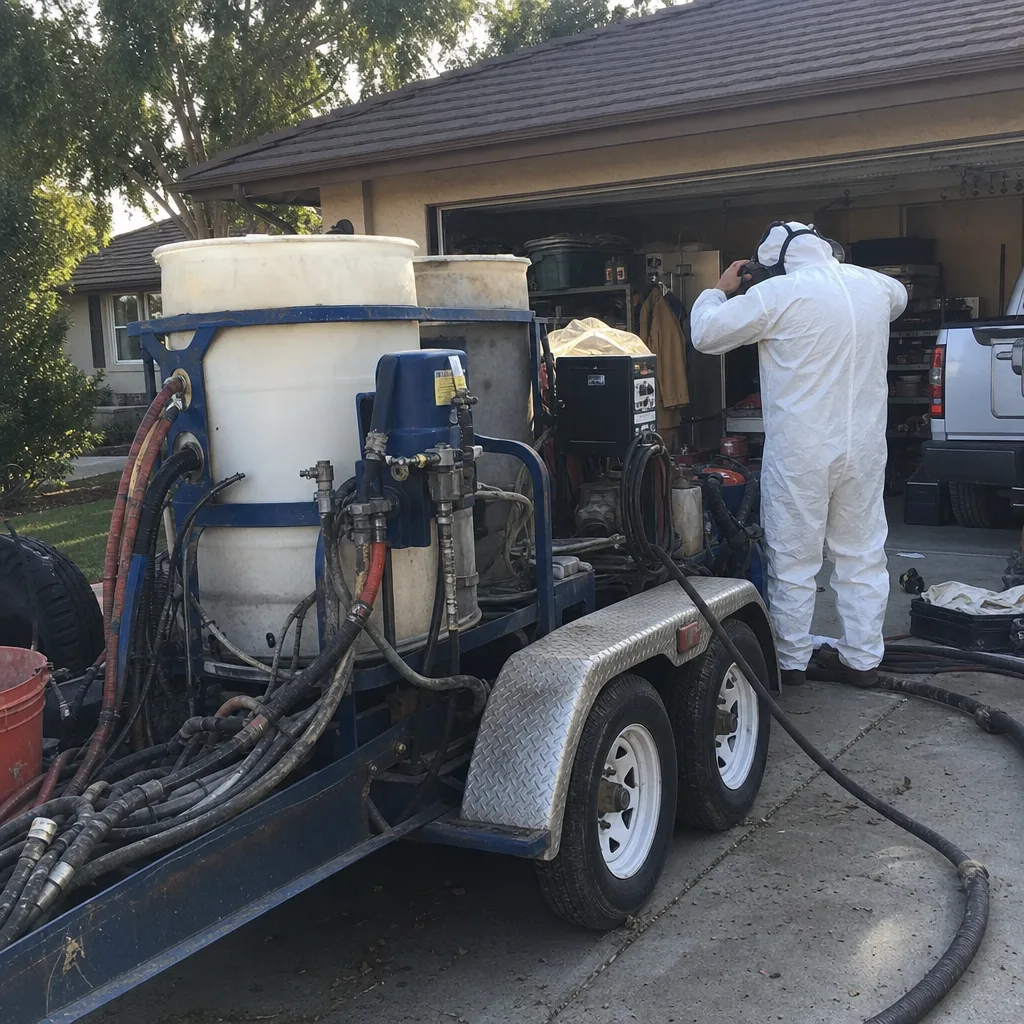
How Much Does Spray Foam Insulation Cost in Orange?
Our Spray Foam Insulation services in Orange, CA typically cost between $1.50 and $4.50 per square foot, depending on whether you’re using open-cell or closed-cell foam, the area being treated, and current job-site conditions. Most Orange homeowners pay between $1,800 and $6,500 for a standard attic or crawl space application, while whole-envelope spray foam projects on larger homes can reach $10,000 or more. We audit before we recommend – so you’ll only pay for what your home actually needs.
Spray Foam Insulation Cost Breakdown (2026)
The table below reflects real Orange market pricing as of 2026. These aren’t national averages pulled from a database – they’re based on what jobs in Orange, Anaheim Hills, Villa Park, and the surrounding corridor actually run.
| Application / Area | Foam Type | Typical Cost Range | Notes |
|---|---|---|---|
| Attic – full coverage (1,200-1,600 sq ft floor) | Open-cell | $1,800 – $3,200 | Sprayed to rafters/roof deck; common in Orange’s climate |
| Attic – full coverage (1,200-1,600 sq ft floor) | Closed-cell | $3,400 – $6,500 | Higher R-value per inch; better moisture resistance |
| Crawl space – encapsulation + spray foam | Closed-cell | $2,200 – $4,800 | Older homes in Old Towne Orange often need prep work first |
| Garage walls + ceiling | Open-cell or closed-cell | $900 – $2,400 | Depends on conditioned vs. unconditioned space goal |
| Rim joists / band joists | Closed-cell | $400 – $900 | High-value air sealing target; often missed by other contractors |
| New construction – wall cavities (per 1,000 sq ft) | Open-cell | $1,200 – $2,800 | Timing with framing stage matters for cost efficiency |
| Existing wall injection (retrofit) | Open-cell low-density | $1,800 – $3,600 | More complex; pricing reflects labor for drilling and patching |
| Whole-home envelope – large homes (2,500+ sq ft) | Mixed (open + closed) | $7,000 – $14,000+ | Typical for Anaheim Hills custom homes or full thermal envelope work |
A few things shape where your project lands in those ranges. Closed-cell foam from Icynene or Demilec – the two spray foam lines we work with at Harbor Insulation Orange – runs higher than open-cell because the chemistry is denser and the material yield per board foot is lower. That said, closed-cell delivers R-6 to R-7 per inch compared to open-cell’s R-3.5 to R-4, which makes it the right call for tight spaces where you physically can’t spray thick enough to hit code with open-cell.
Labor is a real cost driver that doesn’t get enough attention in online price guides. When the owner installs it – every time – the hourly rate reflects skill and accountability, not the lowest sub who showed up. That’s a deliberate positioning for us. You’re not paying more for a name on the door; you’re paying for the person who knows what they’re doing to be the one holding the spray gun.
Orange’s building stock also affects price. Homes in the Historic District near Old Towne are often built on pier-and-beam foundations with crawl spaces that have decades of accumulated issues – blocked access, deteriorating vapor barriers, pest damage – all of which add prep time before foam ever touches a surface. Newer construction in areas like Orange Park Acres tends to be more straightforward but often has larger square footage.
What Affects Spray Foam Insulation Pricing in Orange
- Open-cell vs. closed-cell foam chemistry: Open-cell foam (from our Icynene or Demilec product lines) costs roughly $1.50-$2.00 per square foot installed. Closed-cell runs $3.00-$4.50. The gap exists because closed-cell uses more raw material per inch and requires higher chemical temperatures during application – both of which add to job cost. In Orange’s climate, where attic temperatures regularly hit 140-160°F in July and August, closed-cell’s higher R-value per inch often makes it worth the premium for roof deck applications.
- Inches of foam required: California’s Title 24 energy code drives minimum performance requirements, and meeting those requirements in a retrofit application is not always as simple as spraying a standard thickness. If we’re bringing an Orange home’s attic up to current code from a condition of no insulation or failed batt insulation, the required board-feet of foam goes up – and so does the material cost. We measure and calculate this during the home energy audit, not on the fly during install.
- Accessibility and job-site conditions: A clean, open attic with a standard scuttle and full standing height is fast to work in. A cramped, low-pitch attic over a 1950s ranch home in Serrano Heights – with existing blown-in cellulose that hasn’t been removed yet – is not. Access difficulty, existing material removal, and attic geometry all affect labor hours directly.
- Whether insulation removal is needed first: Many Orange homes we audit have existing insulation that’s either contaminated (rodent activity is common in older neighborhoods near Santiago Creek), wet from a slow roof leak, or simply so degraded it’s acting as a thermal sink rather than a barrier. Removing that material before spray foam goes in adds $500-$2,000 to the project depending on volume and contamination level. We handle the full job – from removal to reinstall – rather than applying new foam over a problem.
- Current material and fuel surcharges: Spray foam is petroleum-derived, and regional distribution costs in Southern California add a layer that interior markets don’t face. Supply chain variability in 2025-2026 has kept closed-cell foam pricing somewhat elevated relative to 2022 norms. We price projects at current material cost, not a rate card printed two years ago.
- Permit and inspection requirements: Orange follows California’s Title 24 and CRC building code. Most spray foam applications on existing homes fall under permitted work in Orange if they’re part of a structural or HVAC-adjacent project, though some retrofit applications fall into a gray zone that we clarify before work begins. When a permit is pulled, inspection scheduling adds time to the project timeline (not always cost, but worth knowing).
Open-Cell vs. Closed-Cell: Which Is Right for Orange, CA?
This question comes up on nearly every estimate we do in Orange, and the answer isn’t the same for every home. Here’s how we actually think through it.
Where Open-Cell Foam Makes Sense
Open-cell foam from our Icynene or Demilec product lines expands aggressively on contact – up to 100 times its liquid volume – which makes it excellent at filling irregular cavities, reaching into corners, and sealing air gaps that are difficult to target with batt insulation. Its softer structure also makes it forgiving in wood-framed cavities that experience seasonal movement, which matters in Orange’s climate where summer heat cycles can stress framing.
Open-cell is the right call for interior wall cavities (soundproofing + thermal), vaulted ceiling spaces where you have room to spray thick, and attic applications where the goal is air sealing above the depth requirement for thermal performance alone. At R-3.5 to R-4 per inch, you’ll typically need 5-6 inches to meet Title 24 standards for Orange’s climate zone (Zone 8 in most of the city, Zone 10 in Anaheim Hills and the higher-elevation areas).
Where Closed-Cell Foam Is the Better Investment
Closed-cell foam is structurally rigid, vapor-permeable resistant, and delivers R-6 to R-7 per inch. In Orange’s coastal-adjacent climate, where overnight marine layer keeps humidity elevated from May through September, closed-cell’s moisture resistance is a real performance advantage – particularly for crawl space walls, rim joists, and roof deck applications where liquid water intrusion is a risk.
For Anaheim Hills homes at higher elevation that see more temperature swing between summer and winter, closed-cell on the roof deck creates a genuine unvented attic assembly that dramatically reduces the thermal load on HVAC equipment. We’ve seen energy bills drop 25-35% on these projects in the right home conditions. That’s not a marketing claim – it’s the kind of result that only happens when the right foam goes in the right place at the right thickness.
Our Spray Foam Insulation in Orange service page goes deeper on product selection and application methodology if you want the technical detail before calling.
Why Orange’s Climate Makes Spray Foam a Strong Choice
Orange sits in a climate zone that most national insulation guides underestimate. Yes, it’s Southern California – but that doesn’t mean insulation is an afterthought. The combination of radiant heat loading from clear-sky summers, cool marine air that pushes through the Whittier Narrows corridor on summer evenings, and mild but real winter heating demand creates a thermal performance challenge that’s distinctly different from, say, Phoenix or San Francisco.
Attic temperatures in Orange routinely exceed 150°F in July and August. That heat radiates down through the ceiling plane and forces air conditioning systems to work harder than they should. Spray foam applied directly to the roof deck – creating what building scientists call an “unvented attic assembly” – keeps that heat outside the thermal envelope rather than trapping it in the attic space above your insulation. The difference in attic air temperature between a vented attic with batt insulation and an unvented attic with closed-cell spray foam on the roof deck can be 40-50°F on a peak summer day.
For homes near Santiago Creek, the Irvine Park area, and other zones where mature tree canopy and soil moisture keep humidity higher than the surrounding area, closed-cell foam’s vapor retarder properties are a practical benefit, not just a spec sheet detail.
How to Save on Spray Foam Insulation in Orange
There are legitimate ways to reduce the total cost of a spray foam project without cutting into the performance you’re actually paying for. Here’s what actually moves the number.
- Start with a home energy audit. We audit before we recommend – that’s not a sales line, it’s the workflow. An audit tells us exactly where the thermal and air sealing failures are in your home. Homeowners who skip the audit and just ask for “spray foam everywhere” often pay for material in areas that have marginal impact and miss the two or three spots that would have made a real difference. The audit focuses your spend.
- Combine services into a single mobilization. The cost to stage a spray foam job – material prep, equipment setup, masking, PPE, cleanup – is largely fixed regardless of project size. If you’re planning spray foam in the attic and your crawl space also needs attention, doing both in the same visit drops your per-square-foot effective cost. We’ll tell you this upfront rather than letting you come back twice.
- Check for California and utility rebates. Southern California Edison and SoCal Gas both run insulation upgrade rebate programs that Orange homeowners qualify for. The amounts change, and program availability has tightened in recent years, but rebates of $200-$800 on qualifying projects are realistic. We can walk you through what’s currently available when we do the estimate.
- Time the project before HVAC replacement. If your air conditioning system is nearing end of life, insulating first can change the size of system you actually need. An HVAC contractor sizing equipment for an under-insulated home will recommend a larger (more expensive) unit than the home needs after spray foam goes in. Getting the envelope right first can save more on the HVAC side than the foam costs.
- Don’t over-specify the foam type. Closed-cell is the right call in the right places – it’s not always the right call everywhere. Open-cell at full depth in a high-pitch attic with good moisture conditions can match the performance of closed-cell at a meaningfully lower material cost. We match the product to the situation rather than defaulting to the premium option on every job.
Get a free estimate before you make any decision. Call us at (657) 530-5638 – there’s no commitment, and you’ll leave the conversation knowing exactly what your home needs and why, not just a number on a piece of paper.
What the Spray Foam Installation Process Looks Like
Understanding the process helps you evaluate quotes more critically – and spot the corners that some contractors cut.
Step 1: Home Energy Audit
Before any material recommendation, we assess the full thermal envelope. This includes the attic, walls, crawl space, windows, air penetrations, and existing insulation condition. In Orange, we also look at how the home’s orientation interacts with summer sun angles – a west-facing wall in Orange Park Acres takes a very different thermal load than a north-facing wall in the same neighborhood. The audit is the foundation, not an upsell.
Step 2: Preparation and Protection
Spray foam overspray is permanent on surfaces it wasn’t meant to hit. Proper masking of light fixtures, HVAC equipment, wiring, and framing members that need to stay exposed is non-negotiable. This prep work takes time and it’s where rushed jobs cut corners. When the owner installs it, the person accountable for the quality is also the person doing the masking.
Step 3: Application
Foam is mixed at the gun tip at precise temperature ratios – off-ratio foam is one of the most common quality failures in spray foam work and it’s invisible until it starts peeling or underperforming. Both Icynene and Demilec products we use have specific application parameters that have to be followed for the material to cure and perform to spec. This is not a job for someone learning the equipment on your roof deck.
Important safety note: During and immediately after application, spray foam chemistry releases isocyanates – compounds that are serious respiratory and skin hazards. No homeowner or untrained person should be in the work area during application. Proper ventilation and a cure period (typically 24 hours minimum before re-entry for extended occupancy) are required. This is a skilled trade application, not a DIY task. We follow all OSHA and manufacturer safety protocols on every job, and we’ll tell you exactly when your space is safe to re-enter.
Step 4: Inspection and Cleanup
After foam cures, we inspect coverage for voids, thickness uniformity, and proper adhesion at transitions. Any surfaces that need trimming for code clearance get addressed. Overspray masking comes down. The job isn’t done until the space is clean and the work is verified, not just complete.
Spray Foam vs. Other Insulation Types: Quick Cost Comparison
Spray foam is not always the highest-value choice for every application. Here’s an honest comparison for Orange homeowners weighing their options.
- Spray foam (open-cell): $1.50-$2.00/sq ft installed. Best air sealing performance, good for large cavities and attic applications.
- Spray foam (closed-cell): $3.00-$4.50/sq ft installed. Best R-value per inch, vapor retarder, structurally additive. Premium cost is justified in specific applications.
- Blown-in fiberglass or cellulose (attic floor): $0.90-$1.60/sq ft installed. Good thermal performance at depth, lower cost per R-value – but does not air seal and performs poorly with air movement through the material.
- Batt insulation (walls): $0.50-$1.20/sq ft installed. Lowest upfront cost, but installation quality is highly variable and air leakage is not addressed.
- Radiant barrier (attic): $0.75-$1.25/sq ft installed. Addresses radiant heat specifically – often the highest-ROI single upgrade for Orange homes with clear-sky sun exposure and older attics.
We stock and install all of these – from Owens Corning and Johns Manville batts to GreenFiber blown-in cellulose to Knauf and CertainTeed fiberglass products, alongside our Icynene and Demilec spray foam lines. The right material for your home’s specific situation is the one we recommend – not the one with the best margin.
From the home page, you can explore all ten services we offer and get a full picture of what a whole-envelope approach looks like for an Orange home.
FAQs – Spray Foam Insulation Cost in Orange
How much does spray foam insulation cost per square foot in Orange, CA?
Open-cell spray foam in Orange runs $1.50-$2.00 per square foot installed; closed-cell runs $3.00-$4.50 per square foot installed. Those ranges reflect the Southern California market as of 2026, including regional material costs and local labor rates. The exact number for your home depends on access conditions, foam type, required thickness, and whether any prep work (like insulation removal or moisture remediation) is needed first. Call (657) 530-5638 for a free, site-specific estimate – we don’t quote accurately without seeing the space.
Is spray foam insulation worth it for an Orange, CA home?
For most Orange homeowners with under-insulated attics or crawl spaces, spray foam delivers measurable ROI – typically through reduced cooling costs that average 20-35% on homes where it addresses the primary thermal failure points. Orange’s summer peak load is high enough that air conditioning savings alone often justify the investment within 5-8 years, with the foam performing for 30-plus years with no degradation. The calculation changes if your home already has modern attic insulation in good condition – which is why we audit before recommending anything. Call (657) 530-5638 and we’ll tell you honestly whether spray foam is the right answer for your specific situation.
What is the difference between open-cell and closed-cell spray foam for an Orange home?
Open-cell foam is lighter (about 0.5 lb per cubic foot), costs less, and expands dramatically to fill large cavities – it’s R-3.5 to R-4 per inch and is best for interior wall cavities, high-pitch attics, and soundproofing applications. Closed-cell is denser (2 lb per cubic foot), costs more per square foot, delivers R-6 to R-7 per inch, and acts as a vapor retarder – making it the better choice for crawl space walls, rim joists, roof deck applications, and any area with moisture exposure risk. In Orange’s climate, we often use both on the same home: closed-cell where moisture or limited-depth situations demand higher R-value per inch, open-cell where we have the depth and the budget constraint matters. Call (657) 530-5638 and we’ll walk you through which makes sense where in your home.
How long does spray foam insulation last in Orange?
Properly installed spray foam – both open-cell and closed-cell from quality manufacturers like Icynene and Demilec – has a service life of 30-80+ years when applied correctly and not exposed to UV degradation (closed-cell exposed to direct sunlight needs to be coated). It doesn’t settle, compress, or absorb moisture under normal conditions, which is a significant durability advantage over batt or blown-in products. In Orange’s climate, we do see cases where poorly installed foam from earlier contractors has delaminated or cured off-ratio – which is why application skill matters as much as material quality. If you’re uncertain about existing spray foam in your home, call (657) 530-5638 and we can assess it during a home energy audit.
Can spray foam insulation be installed in an existing Orange home, or only new construction?
Spray foam can absolutely be installed in existing Orange homes – and most of the work we do is in existing homes rather than new construction. The method varies by location: attic and crawl space applications are straightforward because the space is accessible. Wall retrofit applications require drilling small access holes in each stud bay and injecting low-density open-cell foam, then patching – more labor-intensive but very effective when walls are the thermal weak point. We’ve done both in Old Towne Orange historic homes and newer builds in Anaheim Hills. The audit determines what’s feasible and what the best approach is for your specific home. Call (657) 530-5638 for a free assessment.
Does spray foam insulation require a permit in Orange, CA?
It depends on the scope. Most attic spray foam retrofit applications in Orange do not require a permit if they are not part of a larger structural or mechanical project. However, California’s Title 24 energy code standards apply regardless of permit status – meaning the installation has to meet code-minimum performance requirements even if no inspector is verifying it. We follow Title 24 requirements on every job, permitted or not. If your project does require a permit (common with new construction or HVAC-adjacent work), we’ll identify that upfront so there are no surprises during the project. Call (657) 530-5638 with your project details and we’ll walk you through what’s required.
Harbor Insulation Orange: The Owner Installs It, Every Time
Every spray foam job we do in Orange is installed by the same person who assessed your home, explained the options, and quoted the price. There’s no crew dispatch, no subcontractor handoff, no junior installer learning the equipment on your roof deck. That’s not a marketing line – it’s the operational model, and it’s why the work gets done right the first time.
We use Icynene and Demilec spray foam products specifically because they perform to spec when applied correctly and have track records we trust. We don’t work with whatever foam is cheapest at the regional distributor this quarter. And because we also offer blown-in insulation, batt installation, radiant barrier, crawl space encapsulation, and full insulation removal and replacement, we’re not incentivized to push spray foam where a different product is actually the better answer. Your entire thermal envelope, handled as one system – that’s what Harbor Insulation Orange does.
If you’re an Orange homeowner dealing with high energy bills, rooms that won’t cool down, or previous insulation work that clearly didn’t solve the problem, the first step is an honest assessment – not a quote for material you may or may not need. Call (657) 530-5638 and we’ll schedule a home energy audit and free estimate. We’ll tell you what your home actually needs, where the real thermal failures are, and what the investment looks like to fix them properly.
Pricing reflects the Orange, CA market as of 2026. Harbor Insulation Orange offers free estimates – call (657) 530-5638.
Written by the Owner & Lead Installer at Harbor Insulation Orange, serving Orange, CA and surrounding communities.
What Our Customers Say
"Told me the crawlspace didn't need doing and only the attic did. Half the job, half the money."
— Megan Thompson"Work is good and the house is noticeably more comfortable. There was insulation debris left in the hall closet under the attic access that I had to clean up."
— Norma Flores"Plastic laid from the front door to the attic hatch and they vacuumed the hallway afterward."
— Vikram Sharma